
XtremeMarkets

Market News

Japanese Yen Strengthens as Traders Anticipate BoJ Rate Hike

Japanese Yen Strengthens as Traders Anticipate BoJ Rate Hike

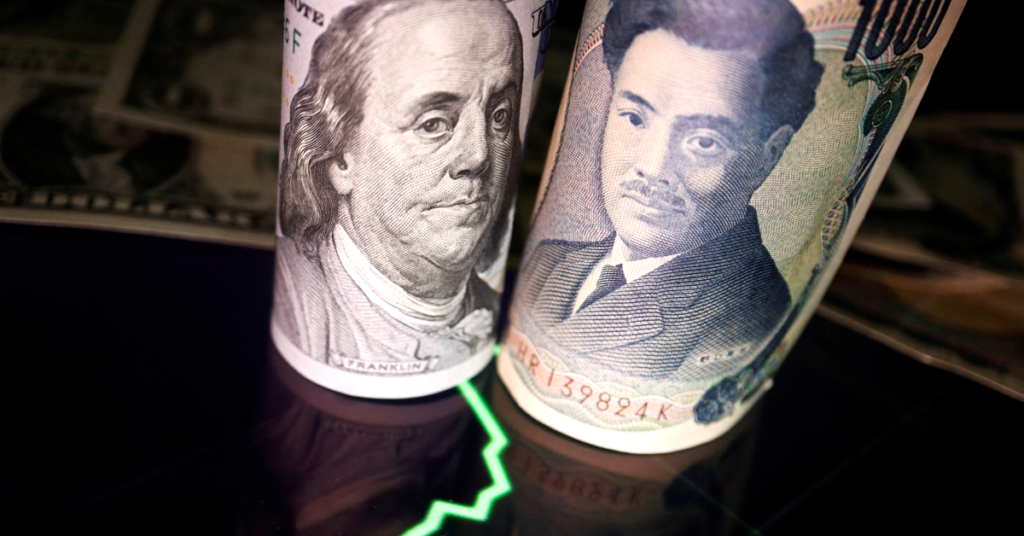
The Japanese Yen (JPY) continues to gain momentum for the second consecutive day as Bank of Japan (BoJ) Governor Kazuo Ueda’s hawkish comments stand in stark contrast to the dovish tone of Federal Reserve Chair Jerome Powell.

In a speech to Parliament on Friday, Governor Ueda suggested that the BoJ might consider further interest rate hikes if economic conditions align with their projections. July’s National Consumer Price Index (CPI) data remained at its highest level since February, further supporting the BoJ’s hawkish outlook.

Meanwhile, the US Dollar (USD) is weakening due to increasing expectations of a rate cut in September. During the Jackson Hole Symposium, Fed Chair Powell remarked, “The time has come for policy to adjust,” though he did not specify the timing or scale of the potential cuts.

Market participants are now widely anticipating a 25 basis point (bps) rate cut from the Federal Reserve in September. The CME FedWatch Tool shows that markets are fully pricing in at least this amount.

Daily Market Movers: Japanese Yen Rises on BoJ Ueda’s Hawkish Comments

Bloomberg reported that Philadelphia Fed President Patrick Harker emphasized the need for a gradual reduction in US interest rates. Reuters added that Chicago Fed President Austan Goolsbee noted that monetary policy is currently at its most restrictive level, with the Fed now focusing on achieving its employment mandate.

Governor Ueda, speaking before the Japanese parliament on Friday, clarified that the BoJ is “not considering selling long-term Japanese government bonds (JGBs) as a tool for adjusting interest rates.” He added that any reduction in JGB purchases would only account for about 7-8% of the balance sheet, which is a relatively small decrease. Ueda further mentioned that if the economy meets their projections, there could be a phase where interest rates might be adjusted slightly higher.

Japan’s National CPI rose by 2.8% year-on-year in July, maintaining this rate for the third consecutive month and remaining at its highest level since February. Additionally, the National CPI excluding Fresh Food increased by 2.7%, the highest reading since February, in line with expectations.

In the US, the Composite PMI edged down slightly to 54.1 in August from 54.3 in July, a four-month low but still above market expectations of 53.5. This indicates continued growth in US business activity, marking 19 consecutive months of expansion.

The FOMC minutes from July’s policy meeting revealed that most Fed officials were in agreement that a rate cut is likely at the September meeting, provided that inflation continues to cool.

Technical Analysis: USD/JPY Drops Near 144.00

USD/JPY traded around 143.90 on Friday, with the daily chart indicating the pair is positioned below a downtrend line, suggesting a bearish outlook. However, the 14-day Relative Strength Index (RSI) remains slightly above 30, indicating that the bearish trend might persist.

On the downside, the USD/JPY pair may approach the seven-month low of 141.69, recorded on August 5. A break below this level could drive the pair toward the throwback support level at 140.25.

In terms of resistance, the USD/JPY pair may test the immediate barrier at the downtrend line around the psychological level of 145.00, followed by the nine-day Exponential Moving Average (EMA) at the 145.74 level. A breakthrough above the nine-day EMA could lead the pair to explore the region around the throwback-turned-resistance at the 154.50 level.


Gold Price Holds Below $2,500 as Traders Await Powell’s Speech

Gold Price Holds Below $2,500 as Traders Await Powell’s Speech

Gold (XAU/USD) is seeing some dip-buying on the last trading day of the week, partially recovering from Thursday’s over 1% drop to a weekly low. The US Dollar (USD) is struggling to build on its overnight rebound from the year-to-date low, due to expectations of lower interest rates in the US. This dovish outlook has triggered a decline in US Treasury bond yields, putting pressure on the Greenback. Additionally, ongoing geopolitical risks are providing support to the safe-haven appeal of gold.

However, traders remain cautious and are avoiding significant bullish positions ahead of Federal Reserve Chair Jerome Powell’s speech at the Jackson Hole Symposium later today. This hesitation is keeping gold prices below the key psychological level of $2,500 as the European session approaches. Powell’s remarks will be closely analyzed for indications regarding the Fed’s potential rate-cut path, which will significantly impact near-term USD price movements and offer new directional momentum for gold.

Daily Market Movers: Gold Traders on Standby for Powell’s Speech

On Thursday, the US Dollar staged a solid recovery from its 2024 low, buoyed by rebounding US Treasury bond yields, which drew investors away from gold. However, the USD’s recovery lacked sustained momentum due to market speculation that the Federal Reserve might begin a rate-cutting cycle in September, limiting losses for XAU/USD.

On the economic data front, the US Department of Labor reported that initial jobless claims rose to a seasonally adjusted 232,000 for the week ending August 17, up from the previous 228,000. This followed an annual benchmark review revealing that US employers added 818,000 fewer jobs than initially reported for the year through March.

Minutes from the Federal Open Market Committee (FOMC) meeting on July 30-31 showed an increasing number of policymakers supporting a rate cut next month due to progress in reducing inflation. The S&P Global flash PMI indicated that US manufacturing activity contracted at its fastest pace this year, although the services sector saw a surprise increase. The composite PMI showed continued healthy expansion in US private sector business activity, with selling price inflation nearing pre-pandemic levels.

Comments from regional Fed officials reflect a cautious stance on rate cuts. Kansas City Fed President Jeffrey Schmid emphasized the need for more data to support a rate reduction, while Philadelphia Fed President Patrick Harker indicated openness to a September cut, contingent on economic data. Boston Fed President Susan Collins also suggested that a rate cut would soon be appropriate as inflation data stabilizes.

Market attention is now focused on Fed Chair Jerome Powell’s upcoming speech, which will be pivotal in signaling the future trajectory of interest rates and influencing gold’s direction.

Technical Analysis: Gold’s Setup Suggests Potential for Further Gains

From a technical perspective, gold’s recent decline found support near the $2,370 horizontal resistance-turned-support level, which now serves as a crucial pivot point. A decisive break below this level could trigger technical selling, pushing gold prices towards the next support area around $2,345-$2,343. Further downside could extend towards the 50-day Simple Moving Average (SMA), currently positioned just above the $2,400 mark.

Conversely, if gold can regain momentum above the $2,500 level, it will face initial resistance around the $2,513-$2,514 region. Clearing this hurdle could open the door to testing the all-time high near $2,531-$2,532, potentially reigniting bullish momentum and extending gold’s recent uptrend.

US Dollar Faces Continued Pressure as Market Focus Shifts to PMI Data

US Dollar Faces Continued Pressure as Market Focus Shifts to PMI Data

After a brief recovery earlier in the day on Wednesday, the US Dollar Index reversed course during the American session, marking its fourth consecutive day of losses. As of Thursday’s European trading hours, all eyes are on the preliminary August PMI data from Germany and the Eurozone, provided by HCOB, alongside the S&P Global/CIPS PMI figures. Later in the day, the US economic calendar will feature weekly Initial Jobless Claims, Existing Home Sales, and S&P Global PMI data.

On Wednesday, the US Bureau of Labor Statistics reported a preliminary estimate indicating a benchmark revision for March 2024’s total Nonfarm employment, with a downward adjustment of -818,000 (-0.5%). Additionally, minutes from the Federal Reserve’s July 30-31 policy meeting revealed that a significant majority of policymakers felt that, should the incoming data align with expectations, easing policy at the next meeting would likely be appropriate. The USD Index is currently trading just above 101.20, down over 1% since the start of the week. Meanwhile, US stock futures are slightly lower, and the 10-year US Treasury bond yield remains near the lower end of its weekly range, around 3.8%.

In Asian trading, data from Australia showed the Judo Bank Composite PMI rose to 51.4 in August’s preliminary reading, up from 49.9 in July. However, this improvement failed to significantly impact AUD/USD, which continues to trade sideways around 0.6750.

EUR/USD surpassed 1.1170 on Wednesday, reaching its highest level since July 2023 before entering a consolidation phase early Thursday. The pair is currently steady at around 1.1150.

GBP/USD maintained its bullish momentum on Wednesday, climbing above 1.3100 for the first time in over a year. The pair remains just below this level as of Thursday morning in Europe.

USD/JPY was unable to capitalize on the USD’s broader weakness, closing flat on Thursday. The pair continues to trade sideways around 145.50 at the start of the European session.

Gold, which had corrected from its record high of $2,531 set on Tuesday, stabilized above $2,500 late Wednesday. XAU/USD remains relatively quiet, trading near $2,510 early Thursday.

How Responsible is the Polish Central Bank? – Commerzbank Analysis

How Responsible is the Polish Central Bank? – Commerzbank Analysis

The Polish zloty weakened against the euro and other CE3 currencies yesterday after Poland’s Constitutional Court issued a controversial ruling. The court declared that NBP governor Adam Glapinski could not be held accountable by a parliamentary committee, the State Tribunal, or through any report by such bodies, citing constitutional guarantees of central bank independence. This argument has been used by the previous ruling party (PiS) from the outset of this dispute, notes Commerzbank’s FX Analyst Tatha Ghose.

Zloty Weakens Against the Euro

“We believe this argument lacks merit and doubt that parliament will consider the Constitutional Court’s ruling as binding. Poland’s Constitutional Court has been compromised since the rule of law disputes with the EU and lacks legitimacy. Other key courts are also dominated by right-wing PiS affiliates. The accusations from both sides are driven by ideology rather than good faith.”

“On balance, it seems clear that Glapinski’s ’emergency’ rate cuts just before the elections, coupled with his refusal to cut rates further after an opposing political party took over, were politically motivated. The NBP cannot now claim ‘central bank independence’ after failing to uphold its constitutional duty to remain apolitical.”

“The new KO government will likely proceed with the planned Sejm procedures despite the court’s ruling, pushing for Glapinski’s suspension. Glapinski, in turn, will likely use the ruling to resist interrogation. This standoff is expected to continue in parliament for the next year without a clear resolution. As a result, monetary policy is likely to remain highly politicized and stagnant during this period.”

EUR/USD Approaches YTD Highs Near 1.1050 on Expectations of Fed Rate Cuts

EUR/USD Approaches YTD Highs Near 1.1050 on Expectations of Fed Rate Cuts

The EUR/USD pair climbed to year-to-date (YTD) highs, nearing 1.1040, during early European trading on Monday. This rise is supported by a broad weakening of the US Dollar (USD) amid increasing speculation that the Federal Reserve (Fed) might cut interest rates in September. Market participants are now keenly awaiting Fed Chair Jerome Powell’s speech on Friday for further insights into potential rate cuts.

On Sunday, San Francisco Fed President Mary Daly expressed greater confidence that inflation is under control, suggesting that it might be time to consider lowering borrowing costs from the current range of 5.25% to 5.5%. Chicago Fed President Austan Goolsbee also cautioned that the US central bank should avoid maintaining restrictive policies longer than necessary. These dovish remarks from Fed officials have added selling pressure on the Greenback and provided a boost to EUR/USD.

Currently, investors are pricing in a roughly 70% chance of a quarter-point Fed rate cut in September, with some expecting a more substantial half-point cut. Morningstar’s chief US economist, Preston Caldwell, noted that the latest CPI report further supports the case for aggressive Fed rate cuts starting in September, with an initial 25 basis point cut projected to bring the Fed Funds rate down to 5.00-5.25%.

Meanwhile, the Euro (EUR) remains resilient as markets anticipate a gradual reduction in interest rates by the European Central Bank (ECB). At the latest press conference, ECB President Christine Lagarde emphasized a cautious, data-dependent approach, stating that policymakers are “not pre-committing to a particular rate path” and will make decisions on a meeting-by-meeting basis.

Japanese Yen Strengthens Amid Hawkish BoJ Sentiment; US Data in Focus

Japanese Yen Strengthens Amid Hawkish BoJ Sentiment; US Data in Focus

The Japanese Yen (JPY) rebounded against the US Dollar (USD) on Friday, likely bolstered by Japan’s strong second-quarter GDP growth, which fuels speculation about a potential interest rate hike from the Bank of Japan (BoJ).

However, the Yen may face headwinds due to political uncertainty in Japan, triggered by reports suggesting that Prime Minister Fumio Kishida will not seek re-election as party leader in September, potentially ending his term as prime minister.

The USD/JPY pair is trending lower as the US Dollar weakens, pressured by declining Treasury yields. Moreover, traders are fully pricing in a 25 basis point rate cut by the US Federal Reserve for September, according to the CME FedWatch tool.

Despite this, the Greenback found some support from recent positive US economic data, which has eased recession fears. Upcoming data, including the preliminary US Michigan Consumer Sentiment Index for August and July’s Building Permits, will be closely watched during the North American session.

Market Highlights: Japanese Yen Rises on Hawkish BoJ Outlook

On Thursday, the US Census Bureau reported a 1.0% month-over-month increase in US Retail Sales for July, reversing June’s 0.2% decline and exceeding the expected 0.3% rise. Additionally, Initial Jobless Claims for the week ending August 9 came in at 227,000, lower than the forecast of 235,000 and down from 234,000 the previous week.

Japanese Economy Minister Yoshitaka Shindo expressed optimism on Thursday, stating that Japan’s economy is expected to recover gradually as wages and incomes improve. He also mentioned that the government will work closely with the BoJ to implement flexible macroeconomic policies.

Japan’s GDP grew by 0.8% quarter-on-quarter in Q2, beating market expectations of 0.5% and rebounding from a 0.6% contraction in Q1. This marks the strongest quarterly growth since Q1 2023. On an annualized basis, GDP grew by 3.1%, surpassing the 2.1% market consensus and reversing a 2.3% contraction in Q1. This is the highest yearly growth since Q2 2023.

Federal Reserve Bank of Chicago President Austan Goolsbee expressed concern on Wednesday about the labor market rather than inflation, noting recent improvements in price pressures alongside weak employment data. He added that the extent of rate cuts will depend on prevailing economic conditions, according to Bloomberg.

US Consumer Price Index (CPI) data showed a 2.9% year-over-year increase in July, slightly down from the 3% rise in June and below market expectations. The Core CPI, excluding food and energy, rose by 3.2% year-over-year, a slight decrease from June’s 3.3% increase, in line with market forecasts.

Prime Minister Fumio Kishida announced on Wednesday that he will not seek re-election as the leader of the Liberal Democratic Party (LDP) in September. Kishida highlighted the need to address Japan’s deflationary pressures by promoting wage and investment growth, with the goal of expanding Japan’s GDP to ¥600 trillion.

Rabobank’s senior FX strategist, Jane Foley, noted that this week’s series of US data releases, along with the upcoming Jackson Hole event, should offer more clarity on potential US policy actions. The primary expectation is for the Fed to cut rates by 25 basis points in September, with another potential cut by year-end.

Technical Analysis: USD/JPY Slips Toward 148.50; Immediate Support at Nine-Day EMA

The USD/JPY pair is trading around 148.80 on Friday. The daily chart indicates that the pair is above the nine-day Exponential Moving Average (EMA), suggesting a short-term bullish trend. However, the 14-day Relative Strength Index (RSI) remains below 50, and further gains would confirm a bullish momentum.

In terms of support levels, the USD/JPY pair may find immediate support at the nine-day EMA, around 148.09. A drop below this level could enhance the bearish outlook, potentially pushing the pair toward the seven-month low of 141.69, recorded on August 5. A continued decline could bring the pair closer to the next support level at 140.25.

On the upside, the USD/JPY pair could target the 50-day EMA at 153.08, with a possibility of testing the resistance level at 154.50, which has shifted from previous throwback support to current pullback resistance.

Australian Dollar Declines as US Dollar Gains Strength Ahead of CPI Inflation Data

Australian Dollar Declines as US Dollar Gains Strength Ahead of CPI Inflation Data

The Australian Dollar (AUD) has weakened against the US Dollar (USD) following an unexpected rate cut by the Reserve Bank of New Zealand (RBNZ) on Wednesday. The RBNZ reduced its Official Cash Rate (OCR) by 25 basis points to 5.25% from 5.50%. Given the close economic ties between Australia and New Zealand, developments in one country can influence the other, impacting their respective currencies.

Despite this, the AUD found some support from recent data showing that Australian wage growth remained strong in the second quarter, leading the Reserve Bank of Australia (RBA) to maintain a hawkish stance on its policy outlook. The RBA kept the cash rate steady at its meeting last week, aiming to return inflation to its 2-3% target range.

RBA Governor Michele Bullock ruled out the possibility of rate cuts within the next six months, emphasizing the bank’s cautious approach to inflation risks and its readiness to raise rates if necessary. Traders are now focused on the upcoming release of Consumer Inflation Expectations and Employment data from Australia on Thursday.

The AUD/USD pair saw support as the US Dollar retreated following weaker-than-expected Producer Price Index (PPI) data from the United States (US) released on Tuesday. Investors are now looking ahead to the US CPI inflation report on Wednesday, which could provide insights into the Federal Reserve’s (Fed) interest rate strategy.

Market Movers: Potential for Australian Dollar Appreciation Amid RBA’s Hawkish Stance

On Tuesday, Atlanta Fed President Raphael Bostic expressed increased confidence in the Fed’s ability to achieve its 2% inflation target, though he noted that more evidence is needed before supporting a rate reduction, according to Reuters.

The US Core Producer Price Index (PPI) rose by 2.4% year-on-year in July, down from the previous 3.0%, and below the expected 2.7%. The overall PPI increased by 2.2% YoY in July, compared to 2.7% in June, missing the market forecast of 2.3%. Month-over-month, PPI rose by 0.1% after a 0.2% increase in June.

In Australia, Westpac Consumer Confidence rose by 2.8% in August, reversing a 1.1% decline in July. Meanwhile, the Wage Price Index saw a 0.8% rise in the second quarter, slightly below the expected 0.9% increase.

RBA Deputy Governor Andrew Hauser attributed persistent inflation to weaker supply and a tight labor market, noting the significant uncertainty surrounding economic forecasts.

However, the AUD’s upside could be limited by safe-haven flows due to rising geopolitical tensions in the Middle East. On Sunday, Defense Minister Yoav Gallant informed US Defense Secretary Lloyd Austin of Iran’s military activities, which suggest preparations for a significant strike on Israel, according to Axios writer Barak Ravid.

Federal Reserve Governor Michelle Bowman also stated on Sunday that she sees ongoing inflation risks and labor market strength, indicating that the Fed may not be ready to cut rates at their next meeting in September, according to Bloomberg.

Westpac recently revised its RBA forecast, now predicting the first rate cut in February 2025, delayed from the previously expected November 2024. They also adjusted their terminal rate forecast to 3.35% from 3.10%, reflecting the RBA’s cautious approach, requiring stronger evidence before considering rate cuts.

Technical Analysis: Australian Dollar Trades Near 0.6650

The Australian Dollar is trading around 0.6640 on Wednesday. Technical analysis of the daily chart shows that the AUD/USD pair is moving within an ascending channel, indicating a strengthening bullish trend. The 14-day Relative Strength Index (RSI) has also moved above the 50 level, confirming the bullish momentum.

On the upside, the AUD/USD pair may test the upper boundary of the ascending channel at the 0.6675 level. A breakout above this level could propel the pair toward its six-month high of 0.6798, achieved on July 11.

In terms of support, the AUD/USD pair could test the nine-day Exponential Moving Average (EMA) at 0.6587, followed by the lower boundary of the ascending channel and the throwback level at 0.6575. A drop below this level could lead to a bearish outlook, potentially pushing the pair toward the throwback level at 0.6470.

Nikkei Index Temporarily Reaches Highest Point in 33 Years

Nikkei Index Temporarily Reaches Highest Point in 33 Years

On Tuesday morning, the Nikkei Stock Average experienced a significant surge, reaching its highest session point in 33 years. This notable increase was primarily driven by the performance of technology stocks, which mirrored the upward trend observed in major tech companies in the United States.

During the morning trading session, the Nikkei Average impressively climbed to 33,990.28, marking a substantial rise of 612.86 points or an increase of 1.8% from its closing figure on the previous Friday. This peak surpassed the prior high, which was recorded on November 20, and it represents the most elevated level the index has achieved since March 1990.

As the morning session wrapped up, the Nikkei Average had slightly receded from its peak but still maintained a robust gain. It closed the morning trade up by 481.21 points, or 1.4%, settling at 33,858.63.

It’s noteworthy that the benchmark index’s all-time high was set at 38,915 in December 1989, a record that remains unbeaten to this day.

In tandem with the Nikkei Average, the broader Tokyo Stock Price Index also saw growth, rising by 0.9% to reach 2,415.74 by the end of the morning session.

The surge in the Nikkei Stock Average on Tuesday can be largely attributed to the strong performance of technology stocks in the U.S. market. This rally in the U.S. occurred during Japan’s extended weekend, a period when the Japanese stock market was closed, hence the delayed reaction in the Japanese market.

The primary contributors to the rise in Japan’s benchmark index were key technology and semiconductor companies. Advantest, a manufacturer of chip-testing devices, saw a significant increase in its stock value, soaring up by 8.5% at one point. Similarly, Tokyo Electron, a company specializing in chip equipment, experienced a notable uptick in its stock price, climbing by 4.9%.

This remarkable growth in the Nikkei Stock Average reflects the interconnected nature of global financial markets, where trends and performances in one major market, like the U.S., can have immediate and significant impacts on others, such as Japan. The rise in technology stocks, both in Japan and the U.S., underscores the sector’s vital role in the current global economic landscape. This event marks a milestone for the Nikkei Average, highlighting the continuing evolution and dynamism of the Japanese stock market.

Asian Markets Decline Following Federal Reserve Minutes, with China at the Forefront

Asian Markets Decline Following Federal Reserve Minutes, with China at the Forefront

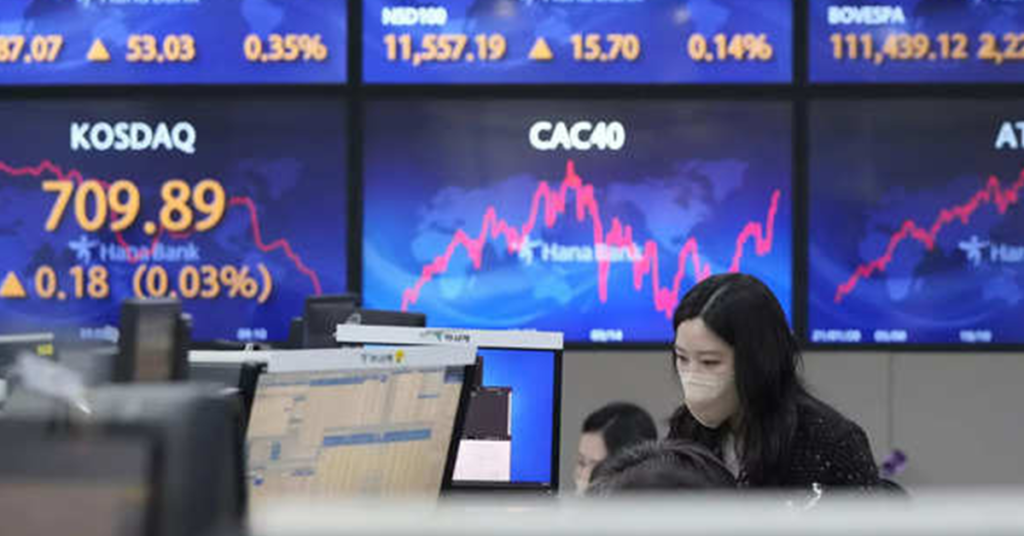
In the Asian financial markets, stocks experienced a downturn, with China’s market fragility contributing significantly to the cautious sentiment following revelations from the Federal Reserve’s meeting minutes. These minutes indicated a likelihood of persistently high interest rates, dampening investor enthusiasm.

As this information settled, a key index tracking Asian stocks continued its decline, marking a third consecutive session of losses. This downtrend was mirrored across various major markets from Australia to South Korea, with Chinese stocks notably experiencing a three-day downward trajectory. Even Japan’s Topix Index, which saw initial gains in its first trading session of the new year following a holiday break, could not escape the overall bearish mood and reversed its early gains.

In the United States, futures remained unchanged during Asian trading hours, reflecting the hesitation in the markets after the S&P 500 concluded Wednesday with a 0.8% decrease. This downturn extends a series of losses initiated in the last trading session of 2023. Similarly, the Nasdaq 100 witnessed a 1.1% drop, marking its fourth consecutive day of declines and the longest losing streak observed in two months.

The focus of investors is now shifting to the forthcoming US employment data expected to be released on Friday. This anticipation is heightened by the Fed’s December meeting minutes, which implied that interest rates might maintain their restrictive levels for an extended period. This has led to a recalibration of expectations among swaps traders, who have tempered their projections for rate cuts, now anticipating a quarter-point reduction to the benchmark rate by the March meeting.

Market analysts, like Jun Rong Yeap of IG Asia Pte, suggest that the prevailing risk-on rally might need a pause. The retreat from previously bullish sentiments on Wall Street, coupled with a strengthening US dollar and increasing oil prices, are posited as potential headwinds for Asian equity markets. As investors digest these developments, the cautious tone in the Asian markets reflects broader concerns over global economic stability and the anticipation of policy directions from key central banks.

Stock Futures Creep Upward in 2023’s Final Trading Session as S&P 500 Nears Record High

Stock Futures Creep Upward in 2023’s Final Trading Session as S&P 500 Nears Record High

As the final trading day of 2023 dawned, stock futures edged higher, signaling a potentially strong year-end close with the S&P 500 flirting with a record high. S&P 500 futures climbed by 0.1%, with a similar modest increase seen in the Nasdaq-100 futures. The Dow Jones Industrial Average futures inched up 28 points, reflecting a subdued optimism in the market. The S&P 500, less than 0.5% away from a new record, hinted at a year capped by a robust rally, particularly reinforced in the year’s final months.

This year has been marked by a remarkable recovery and resilience in stock markets. The Federal Reserve’s indication of a halt in rate hikes and the potential for rate cuts in the upcoming year catalyzed a shift in sentiment. This was evidenced by the 10-year Treasury yield’s significant drop from over 5% to under 3.9%. The prospect of a ‘soft landing’ for the U.S. economy, averting a recession, has further buoyed investors’ confidence, contributing to a broadening market rally in the fourth quarter.

December has been notably strong for smaller companies, with the Russell 2000 index surging nearly 14%, setting it on course for its best month since November 2020. This broadening rally is not just confined to small caps; the industrial-heavy Dow has also been hitting a series of record highs. According to Ryan Detrick, chief market strategist at Carson Group, a surge of 10% or more in the final two months historically suggests a bullish outlook for stocks into the new year.

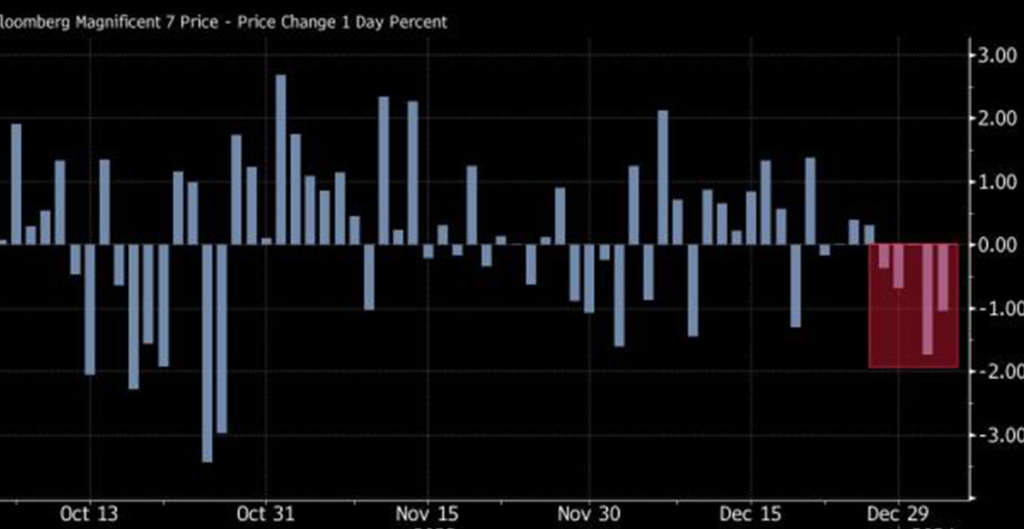
The year 2023 has seen impressive gains across major indexes. The S&P 500 is up by 24.6%, while the Dow has risen by 13.8%. However, the Nasdaq Composite has been the standout, with a 44.2% increase, driven significantly by the booming artificial intelligence sector. This has been the index’s best performance since 2003, largely attributed to substantial gains in tech giants such as Nvidia and Microsoft, dubbed the “Magnificent 7.” These companies have thrived amidst the year’s challenges, including heightened interest rates, by leveraging the AI wave, thus pushing the tech-heavy Nasdaq to outperform.

In summary, as 2023 wraps up, Wall Street is witnessing a potentially historic close, buoyed by strategic rate decisions, a resilient economy, and a tech-led rally. While the future remains uncertain, the current trajectory and historical patterns suggest a continuation of the bullish trend, offering a hopeful outlook for investors as they step into the new year.


Decline in Asian Stock Markets as Wall Street Pullback Concludes Historic Surge

Decline in Asian Stock Markets as Wall Street Pullback Concludes Historic Surge

The recent downturn in Asian stock markets marks a significant shift from the record highs that Wall Street had been experiencing, signaling a more cautious stance from investors. The pullback reflects a recalibration of expectations following a series of less-than-stellar corporate earnings reports and growing concerns that the market’s accelerated growth might not be sustainable. 

In Japan, the Nikkei 225 index suffered a 1.6% decline, closing at 33,140.47. The downward trend was led by Toyota, the prominent Japanese automaker, which witnessed a drop of up to 4% in its stock value. This decline was, in part, a reaction to the company’s announcement of a major recall involving 1 million vehicles due to a malfunctioning airbag issue, which increased the potential risk of injuries to passengers.

This news was compounded by revelations that Daihatsu, a subsidiary of Toyota specializing in small cars, had halted vehicle shipments both domestically and internationally. An investigation had uncovered inadequate safety testing for 64 car models, some of which were manufactured for other major brands like Mazda and Subaru. The seriousness of the situation was underscored by a raid conducted by Japanese transport ministry officials on Daihatsu’s offices.

Elsewhere in the region, the Australian S&P/ASX 200 index slipped by 0.5% to 7,504.10, while South Korea’s Kospi index saw a reduction of 0.6%, ending at 2,600.02. In contrast, the Hang Seng index in Hong Kong remained relatively unchanged, and the Shanghai Composite in mainland China actually posted a gain of 0.6%.

In South Asia, India’s benchmark Sensex index edged up by 0.2%, and a similar modest uptick was observed in Bangkok’s SET index.

The pullback in Asia came in the wake of significant losses on Wall Street, where approximately 95% of the companies listed on the S&P 500 experienced a decline. The S&P 500 itself fell by 1.5%, marking its most substantial loss since the beginning of a notable rally pre-Halloween. The Dow Jones Industrial Average and the Nasdaq composite also faced sharp declines.

One of the key contributors to the bearish sentiment was FedEx, which saw its shares plummet by 12.1% after the company reported revenue and profits for the latest quarter that fell short of analysts’ expectations. This shortfall was attributed to weaker demand, which also led FedEx to revise its full fiscal year revenue projections downwards. Such indicators from a global logistics bellwether like FedEx tend to have broad market implications, hinting at potential softening in worldwide commerce.

However, not all news was negative, as the U.S. economy showed some signs of resilience. Consumer confidence figures and home sales data were more robust than anticipated, which could suggest an underlying strength in the economy. Moreover, there are emerging signs that inflation, a key concern for markets worldwide, may be abating. In the United Kingdom, inflation rates showed an unexpected deceleration, bolstering hope that the Bank of England, alongside other central banks, might ease up on aggressive interest rate hikes in the near future.

In the bond market, U.S. Treasury yields saw minor fluctuations, with the 10-year Treasury note inching up slightly. Oil prices experienced a minor dip, and currency markets saw the U.S. dollar weakening against the Japanese yen, while the euro saw a marginal increase.

As the global economy continues to navigate a landscape of high inflation, potential recessions, and geopolitical uncertainties, the Asian market’s response to these dynamics will be closely watched by investors around the world.

Alphabet’s Stock Surges Due to AI

Alphabet’s Stock Surges Due to AI

Alphabet Inc., the parent company of the search engine behemoth Google, has been making headlines with its stock (NASDAQ: GOOGL)(NASDAQ: GOOG) experiencing a notable surge, closing Monday’s trading session with a 2.4% increase, as reported by S&P Global Market Intelligence. This uptick is part of a larger trend within the technology sector, particularly among companies heavily invested in artificial intelligence (AI) technologies. Alphabet’s recent gains are a testament to the growing confidence among investors in the AI sphere, and 2023 has been a year of significant progress for the company’s stock value.

With AI becoming increasingly central to technological advancement and economic growth, Alphabet’s role as a forerunner in web-search services has positioned it to capitalize on these developments significantly. The integration of AI into its search and digital advertising mechanisms has been instrumental in boosting the company’s market performance. However, Alphabet’s potential in AI extends far beyond Google’s search capabilities.

Alphabet’s diverse portfolio, which includes leadership in mobile operating system software with Android, cloud infrastructure services, and video streaming via platforms like YouTube, provides a multitude of avenues through which the company can harness AI. This broad spectrum of products and services not only fortifies Alphabet’s market presence but also presents numerous opportunities for AI integration, enhancing efficiency and creating new user experiences.

The data-rich environment fostered by Alphabet’s numerous platforms is particularly conducive to AI development. The vast data pools collected are invaluable for training sophisticated AI algorithms, leading to more personalized services and innovative solutions that could define the future of technology.

Investors are taking note of Alphabet’s trajectory in AI and its broader implications for the tech industry. Despite a 54% rise in stock value throughout 2023, Alphabet still presents an attractive proposition for long-term investors. Currently trading at approximately 20 times the forecasted earnings for the next year, the company’s stock offers a potentially lucrative investment for those who adopt a buy-and-hold strategy.

Moreover, Alphabet’s robust infrastructure and unparalleled data analytics capabilities give it a competitive edge in the AI race. While the full scope of Alphabet’s ability to leverage these strengths in AI is yet to unfold fully, its current position in the tech landscape remains robust.

For those investors looking to capitalize on the burgeoning AI and tech sectors, Alphabet’s stock is a compelling option. Despite recent gains, the company’s forward-thinking approach and solid financials suggest that its stock may continue to be a strong performer, making it a potentially sound addition to a diversified investment portfolio.

Dow, S&P Hit Peak Since Jan ’22 as Stocks Rally Before Fed

Dow, S&P Hit Peak Since Jan ’22 as Stocks Rally Before Fed

On Tuesday, U.S. stock markets demonstrated a robust performance, with major indices climbing to their highest points since the early days of 2023. This market buoyancy comes as investors digest a pivotal inflation report ahead of the Federal Reserve’s year-end policy meeting.

The Dow Jones Industrial Average surged, closing up by approximately half a percent. This increase, amounting to over 150 points, marked the index’s third-highest closure in its history. Similarly, the Standard & Poor’s 500 Index saw a rise of about 0.5%, securing its strongest close since January 14, 2022. Not to be outdone, the Nasdaq Composite Index, known for its tech-centric stock listing, led the charge with an increase of roughly 0.6%. This collective ascent brought all three indices to their most elevated closing levels since the commencement of 2022.

Amid this bullish context, the Consumer Price Index (CPI) offered a tempered view on inflation. The report, as detailed by Yahoo Finance’s Alexandra Canal, indicated a modest uptick in consumer prices by 0.1% month-over-month and by 3.1% compared to the previous year, as of November. This marginal rise suggests a relatively stable pricing environment.

Investor sentiment has coalesced around the expectation of a hiatus in the Fed’s interest rate hikes, with the anticipation peaking as the central bank’s two-day assembly approached on Tuesday. Scrutiny has turned to CME FedWatch data, revealing a recalibration of market predictions, with reduced forecasting of a rate decrease in March.

The anticipation extends to the implications of a Federal Reserve rate-hike pause for various financial instruments and services, including bank accounts, certificates of deposit, loans, and credit cards. This pause is critical to financial planning and decision-making for both individual consumers and businesses.

However, core inflation, which strips out volatile food and energy costs, may present a more stubborn front, potentially altering investor expectations on the timeline for rate reductions by the Fed.

In the aftermath of the inflation report, there was a slight pullback in U.S. bond yields. The 10-year Treasury yield witnessed a minor decline, dropping around three basis points to hover near 4.21%. This movement in bond yields is a barometer of investor sentiment, reflecting subtle shifts in market expectations regarding inflation and central bank policy.

Among individual companies, Oracle Corporation’s stock experienced a significant downturn, closing down over 12%. The sell-off was triggered by the technology behemoth’s

Indian Stock Market Remains Steady as Adani and Energy Sector Gains Balance Out Decline in IT Shares

Indian Stock Market Remains Steady as Adani and Energy Sector Gains Balance Out Decline in IT Shares

The Indian stock market showcased a balancing act on Tuesday, with stability being the theme of the day, as the gain in key players from the Adani Group and the broader energy sector managed to counterbalance the decline observed in the information technology sector, following its prior surge.

The National Stock Exchange’s benchmark Nifty 50 index saw a marginal uptick of 0.06% reaching 19,807.15 points. In a parallel trend, the Bombay Stock Exchange’s Sensex experienced a slight dip of 0.06%, settling at 65,932.97 by mid-morning. This equilibrium was attributed to gains in nine out of thirteen industry sectors, with the metals sector outshining the rest by recording a 1.1% gain. This was propelled significantly by Adani Enterprises, which holds a substantial influence on the index with a 16.43% weightage.

A spotlight shone on Adani Enterprises along with Adani Ports and Special Economic Zone as they led the charge among the Nifty 50, soaring by 7% and 3.6% respectively. The Adani group as a whole witnessed an appreciable increase in their stock prices, which ranged from 3% to 15% over the course of the day. These movements came in the wake of the Supreme Court’s decision to hold its judgment on a series of petitions that demanded a court-supervised investigation into allegations brought forward by Hindenburg Research against the conglomerate, allegations which Adani has rebuffed.

Further assurance to investors was provided when the Securities and Exchange Board of India (SEBI) declared that it would not seek additional time to conclude its inquiry into the Adani group. Market analysts interpret the rally in Adani’s stocks as a sign of confidence among investors, indicating that no substantial adverse findings have emerged from SEBI’s investigation into the claims made by Hindenburg Research. Avinash Gorakshakar, the head of research at Profit mart Securities, voiced a note of caution regarding the sustainability of this significant uptick in Adani’s shares.

The energy sector, along with oil and gas, each ascended nearly 1%, a rise that coincided with the softening of oil prices to around $80 per barrel. This price adjustment comes just before the scheduled conference of the Organization of the Petroleum Exporting Countries (OPEC) and its allies. Such a decline in oil prices generally spells good news for nations that import oil, like India, and the companies within it that market oil.

In contrast, the IT sector did not share the same fortune, receding by 0.6% on Tuesday. This sector had previously leaped by 5.07% in the week that ended on November 17, buoyed by milder U.S. inflation data which fueled speculation about a potential halt to interest rate hikes. However, the following week saw the index give up some of those gains, falling by 0.42%. The mixed outcomes across sectors reflect the complex interplay of global economic cues, sector-specific dynamics, and regulatory developments within the Indian stock market landscape.

Gold Struggles Below $3,300 as Fed Rate Cut Hopes Dim Ahead of FOMC Minutes

Gold (XAU/USD) dipped to a one-and-a-half-week low near $3,284 during the Asian trading session on Wednesday, weighed down by a stronger US Dollar and rising Treasury yields. Investors are increasingly convinced that recent US tariff hikes may fuel inflation, prompting the Federal Reserve to keep interest rates elevated for longer. 

The firmer Greenback, bolstered by expectations of prolonged Fed tightening and a robust June jobs report, has dulled the appeal of non-yielding assets like gold. Benchmark 10-year US bond yields also climbed, adding further pressure on the precious metal. 

Market participants remain cautious amid ongoing concerns about the economic fallout from Donald Trump’s aggressive tariff proposals. On Tuesday, the former US President threatened to impose duties of up to 50% on copper and 200% on foreign pharmaceuticals, unsettling global markets. However, gold’s traditional safe-haven demand has yet to see significant support in response. 

Traders are now eyeing the release of the FOMC meeting minutes later today, hoping for clues on the Fed’s rate path. Although a July rate cut appears off the table, markets are still pricing in up to 50 basis points of easing by year-end, likely beginning in October. 

Technically, a break below the $3,300 level, coupled with resistance at the 100-period SMA on the 4-hour chart, signals further downside. Momentum indicators suggest gold could slide towards the next support at $3,270, with a deeper drop towards $3,248–$3,247 not ruled out. 

On the upside, recovery attempts may face initial resistance near $3,310 and stronger barriers around $3,326 and $3,340. A decisive move above $3,360 could open the door to a short-term rebound toward the $3,400 mark. 

Gold Price Climbs Steadily, Eyes Record High Amid Trade War Concerns

Gold (XAU/USD) extends its intraday rally, reaching the $2,880 region during the Asian session on Monday. The gains come in response to US President Donald Trump’s plan to impose new 25% tariffs on all steel and aluminum imports, reigniting fears of a global trade war and driving demand for the safe-haven precious metal. Additionally, concerns that Trump’s protectionist policies could fuel inflation further bolster gold’s appeal as a hedge against rising prices.

Gold Supported by Trade War Fears, But Fed Policy Remains a Concern

Despite strong upside momentum, gold’s gains may face limitations due to the resilient US Dollar (USD) and expectations that the Federal Reserve (Fed) might delay further rate cuts. The strong US employment data released on Friday, coupled with inflationary concerns, has reinforced speculation that the Fed will maintain a cautious stance.

Overbought conditions on the daily chart could also deter traders from initiating fresh bullish positions, especially in the absence of key US economic data early in the week.

Trump’s Tariff Announcement Sparks Market Uncertainty

On Sunday, Trump reaffirmed plans to impose 25% tariffs on all steel and aluminum imports into the US, adding that his administration would match tariff rates imposed by other countries. These announcements have further fueled uncertainty and strengthened gold’s safe-haven appeal.

Meanwhile, geopolitical tensions remain elevated. Russian Deputy Foreign Minister Galuzin stated there are no satisfactory proposals for Ukraine peace talks, dismissing Western statements as mere rhetoric. US Vice President JD Vance is reportedly heading to Germany this week to outline US policy proposals.

Fed Policymakers Express Caution Amid Economic Uncertainty

The latest US Nonfarm Payrolls (NFP) report showed 143K jobs were added in January, falling short of the 170K estimate but offset by an unexpected dip in the Unemployment Rate to 4.0%. While the report provides mixed signals, it has reinforced the belief that the Fed will remain cautious regarding further monetary easing.

Several Fed officials have weighed in on economic policy:

  • Minneapolis Fed President Neel Kashkari stated he would consider supporting further rate cuts if inflation data remains favorable and the labor market stays strong.
  • Chicago Fed President Austan Goolsbee noted that inconsistent US government policies create economic uncertainty, making it difficult to assess inflation trends.
  • Fed Governor Adriana Kugler acknowledged steady US economic growth but warned that progress toward the 2% inflation target remains uneven and slow.

What’s Next for Gold?

A stronger US Dollar could act as a headwind for gold prices, limiting aggressive bullish momentum. Traders will closely monitor Fed Chair Jerome Powell’s semi-annual congressional testimony and the upcoming US consumer inflation figures for further market direction.

Gold Price Bulls Hold Firm, But Overbought Conditions Suggest Caution

Gold (XAU/USD) continues its upward trajectory through the Asian session on Wednesday, reaching a fresh all-time high near $2,858. Concerns about the economic impact of US President Donald Trump’s trade tariffs continue to drive demand for the safe-haven metal. Furthermore, predictions that the Federal Reserve (Fed) would continue its easing cycle, backed by signs of deteriorating momentum in the US labor market, are fuelling demand for the non-yielding yellow metal.


Meanwhile, the US dollar (USD) remains under pressure near its weekly low, with rising expectations of further Fed policy easing, offering an extra lift to gold prices. However, Trump’s decision to suspend tariffs on Canada and Mexico has contributed to a risk-on mentality, which may restrict future gains for XAU/USD. Furthermore, gold is entering overbought territory on the daily chart, implying a short-term consolidation or minor retreat before the advance begins. Traders are now waiting for significant U.S. data releases, such as the ADP private-sector employment report and the ISM Services PMI, for new market signals.

Gold Bulls Retain Control Amid US-China Trade Tensions

Despite the positive risk tone, a further escalation in U.S.-China trade tensions continues to lend support to the upward momentum in gold. In response to President Trump’s latest tariffs, China has imposed targeted duties on US imports, and the threat of a trade war between the world’s two biggest economies has seen gold reach an all-time high on Wednesday.

On the macroeconomic front, the Job Openings and Labor Turnover Survey (JOLTS) released Tuesday revealed a decline in U.S. job openings, dropping to 7.6 million in December from a previous 8.09 million. The data signals a cooling labor market, increasing the likelihood of additional Fed rate cuts. This has kept USD bulls on the defensive and further strengthened XAU/USD.

Trump’s decision to postpone the application of a 25% tax on Canadian and Mexican imports by 30 days has revived hopes that a global trade war can be avoided. However, this has done little to undermine the positive enthusiasm toward gold.

Market players will be keenly monitoring Wednesday’s U.S. economic data, such as the ISM Services PMI and the ADP employment report, which may cause short-term changes in gold prices. However, Friday’s highly anticipated Nonfarm Payrolls (NFP) report continues to be the main focus. Furthermore, any fresh information about trade tariffs is probably going to cause financial markets to become more volatile.

WTI Crude Oil Struggles Near $72.00, 100-Day SMA Holds as Key Support

West Texas Intermediate (WTI) crude oil prices fell from a one-week high on Tuesday, attracting sellers for the second straight session. The commodity trades at $72.00, barely above last week’s one-month low and close to the important 100-day Simple Moving Average (SMA) support. 

US Tariff Delay Weighs on Oil Prices

US President Donald Trump has announced a one-month suspension on newly imposed tariffs on imports from Canada and Mexico, easing worries about potential supply disruptions from two of the country’s main oil suppliers. This development put downward pressure on crude oil prices. Furthermore, fears of lower gasoline demand—driven by the larger economic impact of Trump’s trade policies—are contributing to gloomy sentiment in the oil market.

OPEC+ Stands Firm on Production Policy

Despite Trump’s calls for higher output to combat rising oil prices, the Organization of Petroleum Exporting Countries and its allies (OPEC+) have chosen to keep current production levels. This decision may give some support for crude oil prices, avoiding further losses in the near term.

Key Technical Levels to Watch

Traders will closely monitor the 100-day SMA, currently positioned near the $71.00 mark, which serves as a crucial support level. A decisive break below this threshold could trigger an extended pullback from the recent multi-month highs. Conversely, a bounce from this level may reinforce buying interest and help WTI recover from its recent slump.

Gold Price Trims Intraday Losses but Remains Below $2,800 Amid Stronger USD

The gold price (XAU/USD) recovers some of its losses following the strong Asian session sell-off but remains in negative territory, hovering around $2,785, down about 0.60% for the day. The recent rise in the US Dollar (USD), fueled by President Donald Trump’s decision to impose tariffs on Canada, Mexico, and China, has pushed the greenback closer to a two-year high, weighing on gold and dragging it away from its all-time high of $2,817, hit on Friday.

However, projections that the Federal Reserve (Fed) would lower interest rates twice by the end of 2025, combined with indications about probable economic disruptions from Trump’s trade policies, contribute to gold’s safe-haven appeal. The current risk-off mentality further shields the downside, so bearish traders should exercise caution ahead of this week’s key US macroeconomic data, which begins with today’s ISM Manufacturing PMI release.

Technical Outlook: Gold’s Uptrend Intact Despite Intraday Pullback

From a technical perspective, the intraday decline found support near the $2,772 resistance-turned-support level, which now serves as a pivotal point. A decisive break below this zone could trigger further selling pressure, exposing gold to the next key support levels:


  • $2,755 – Initial downside target
  • $2,740 – Intermediate support
  • $2,725-$2,720 – Strong demand zone
  • $2,700 – Psychological level, a break below which could accelerate losses

Conversely, immediate resistance is seen in the $2,790-$2,800 region, followed by the record high of $2,817. Notably, momentum indicators on the daily chart remain comfortably positive, indicating that gold has not yet reached overbought levels. This provides room for additional upward momentum, confirming the broader bullish trend that began with the December swing bottom.

If gold manages to sustain a move above $2,817, it could pave the way for fresh record highs, with bulls eyeing further gains amid ongoing market uncertainty.

Market Drivers to Watch

US Dollar Strength: The impact of Trump’s tariffs on global trade could continue supporting the USD, potentially weighing on gold.

Federal Reserve Policy: Expectations of rate cuts in 2025 remain a crucial factor for gold’s long-term trajectory.

US Economic Data: The upcoming ISM Manufacturing PMI and Nonfarm Payrolls (NFP) report later this week could trigger volatility in gold prices.

Risk Sentiment: Any escalation in geopolitical or economic tensions could further boost gold’s safe-haven demand.

Overall, while gold has retreated from its highs, the larger bullish trend remains intact, with technical signals suggesting further upward movement as long as critical support levels hold.

WTI Slips to $71.00 Amid Trade Tariff Concerns and Weak China Data

West Texas Intermediate (WTI) crude oil prices edge lower during Wednesday’s Asian session, erasing part of the previous day’s modest recovery from a nearly three-week low. The commodity trades near $71.00, down over 0.25% for the day, and remains vulnerable to further losses amid prevailing bearish sentiment.

Investor concerns persist over US President Donald Trump’s threat to impose trade tariffs on Canada, China, and Mexico by February 1, which could weigh on global fuel demand. Additionally, weak Chinese economic data adds to downward pressure. Official PMIs released on Monday highlighted continued weakness in the world’s second-largest economy and top crude importer, raising concerns over lower consumption.

Further pressure on oil prices comes from Trump’s energy policies, which include plans to ramp up US energy production and calls for the Organization of Petroleum Exporting Countries (OPEC) to increase output to drive prices lower.

With bearish fundamentals dominating, WTI remains susceptible to further downside risks in the near term.

WTI Drops Toward $74.00 as Trump Pressures OPEC to Lower Oil Prices

West Texas Intermediate (WTI), the US crude oil benchmark, trades near $74.10 on Friday, continuing its downward trend after US President Donald Trump urged Saudi Arabia and the Organization of the Petroleum Exporting Countries (OPEC) to reduce oil prices.

Uncertainty surrounding Trump’s proposed tariffs and energy policies adds to the pressure on WTI. Speaking at the World Economic Forum in Davos on Thursday, Trump announced plans to request Saudi Arabia and OPEC to lower oil prices, saying, “I’m also going to ask Saudi Arabia and OPEC to bring down the cost of oil.”

Expectations of increased US production under Trump’s administration further weigh on oil prices. Earlier this week, Trump declared a national energy emergency, leveraging his authority to expedite the approval of oil, gas, and electricity projects that would typically require years of permitting.

Meanwhile, US crude inventories declined for the ninth consecutive week. The US Energy Information Administration (EIA) reported a drop of 1.017 million barrels in crude oil stockpiles for the week ending January 17, following a 1.962 million-barrel decline in the prior week. Market expectations had forecast a larger decrease of 2.1 million barrels.

Oil traders will closely monitor developments surrounding Trump’s energy policies and tariff announcements. Additionally, attention will shift to the preliminary US S&P Global Purchasing Managers Index (PMI) for January, set for release later on Friday. A weaker-than-expected reading could pressure the US Dollar (USD), potentially offering some support to the USD-denominated WTI price.

Yuan Falls to Lowest Level Since November as China Permits Declines

Yuan Falls to Lowest Level Since November as China Permits Declines

China’s onshore yuan dropped to its weakest level since November, signaling that policymakers are gradually allowing the currency to decline against a resilient US dollar. The yuan fell to as low as 7.2487 per dollar as the People’s Bank of China (PBOC) gradually reduced its daily reference rate for the managed currency, reaching a level not seen in four months. This move coincided with a strengthening of the greenback, driven by market expectations that the Federal Reserve is not close to initiating a rate-cut cycle.

The PBOC is navigating a complex balancing act, attempting to weaken the yuan at a pace that supports economic growth without triggering market panic or capital outflows. Throughout the year, the central bank has maintained a steady yuan, but pressures have mounted due to worsening capital outflows and sluggish domestic growth.According to Ken Cheung, chief Asian FX strategist at Mizuho Bank, the PBOC may permit further yuan depreciation. The central bank appears to be focusing on managing the pace of yuan depreciation rather than defending a specific level, particularly in the context of a prolonged high-rate environment in the US.

The yuan’s struggles are not unique in Asia. Japan’s currency recently hit its lowest level against the pound since 2008, and currencies such as the Thai baht and Indonesian rupiah are nearing multi-year lows. These Asian currencies are under pressure due to their wide yield discount compared to the US, which benefits the dollar. This rate gap is further intensified by expectations that the Federal Reserve will not cut rates soon, given the surprisingly resilient US growth and persistent inflation.

Christopher Wong, a strategist at Oversea-Chinese Banking Corp., noted that the higher dollar-yuan rate aligns with broader dollar movements as US yields resumed their upward trend. He added that the yuan is likely to weaken further due to the still-wide rate differentials with the US and the anticipation of more US-China trade frictions.

In summary, the yuan’s recent decline reflects broader regional currency struggles amid a robust dollar and high US interest rates. The PBOC’s careful management of the yuan’s depreciation is aimed at balancing economic support with market stability, a challenge complicated by external economic pressures and domestic growth concerns. As the situation evolves, the market will closely watch the PBOC’s actions and their impact on the broader economic landscape.

Japan Wary of Weak Yen’s Downsides, Finance Minister Notes

Japan Wary of Weak Yen’s Downsides, Finance Minister Notes

Japanese Finance Minister Shunichi Suzuki expressed concerns on Tuesday about the current depreciation of the yen, emphasizing the negative effects more than the positives. Suzuki highlighted the challenges posed by a weak yen, including increased costs for companies and consumers due to higher import prices, during a session with a parliamentary committee.

Suzuki pointed out that Japan’s economic policy aims to secure wage growth that outpaces price increases. Given this goal, the adverse impacts of the yen’s weakness are currently a more significant concern for the government.

Furthermore, Suzuki confirmed that Japanese authorities would maintain vigilance over the currency’s influence on the economy and households, and would take necessary actions as required.

The yen has been performing poorly, hovering around 157 per dollar, with a recent position at 156.80 per dollar during early trading in Asia on Tuesday.

Additionally, over the recent weekend, finance leaders from the Group of Seven (G7) advanced nations reiterated their stance against excessively volatile currency movements. This reaffirmation is seen by Japan as support for potential market interventions to stabilize sharp declines in the yen’s value.

Lane Asserts ECB Must Maintain Restrictive Stance Throughout the Year

Lane Asserts ECB Must Maintain Restrictive Stance Throughout the Year

The European Central Bank (ECB) is poised to initiate interest rate cuts as early as next month, yet Chief Economist Philip Lane emphasizes the necessity to maintain a restrictive monetary policy throughout 2024. In a recent interview with the Financial Times, Lane highlighted that although the ECB plans to ease off the most stringent levels of restriction, the overall policy stance for the year needs to remain tight to stabilize the economic landscape.

Lane indicated that barring any major unforeseen events, the conditions are ripe for beginning to lift the uppermost restrictions at the upcoming June 6 meeting. This initial step in monetary easing has been largely anticipated by financial markets, though the trajectory for subsequent rate adjustments remains uncertain. Current market speculations suggest that the ECB might skip adjustments in July and opt to resume rate reductions in September, aligning with statements from more conservative ECB officials like Joachim Nagel and Isabel Schnabel. Meanwhile, other members of the Governing Council have not publicly disclosed their positions.

Looking ahead to 2024, Lane anticipates a shift in discussions as inflation is expected to come closer to the ECB’s target. The focus will then turn to aligning interest rates with this inflation target, heralding a different phase in the ECB’s monetary policy approach.

Recent economic indicators add complexity to the ECB’s decision-making process. Preliminary data suggests a potential uptick in inflation for May. The core inflation measure, which excludes volatile items such as energy and is a key focus for the ECB, appears to have stabilized for the first time since last July. Furthermore, a significant wage growth indicator for the first quarter showed acceleration, although Lane remarked that the general trend in wage movements still points towards a slowdown, which he considers crucial.

Lane describes the path ahead as “bumpy” and “gradual,” indicating that the ECB’s approach to monetary policy adjustment will be carefully measured to navigate the evolving economic conditions effectively.

UK Inflation Hits 3-Year Low; PM Sunak Prioritizes It for July 4 Election

UK Inflation Hits 3-Year Low; PM Sunak Prioritizes It for July 4 Election

In April, the UK experienced a significant decrease in inflation, reaching its lowest level in nearly three years, primarily due to substantial reductions in domestic bills, according to official statistics released Wednesday. This decrease prompted Prime Minister Rishi Sunak to schedule a general election for July 4.

The Office for National Statistics reported that the annual consumer prices index dropped to 2.3% in April, a decline from 3.2% in March. This marked the lowest inflation rate since July 2021, a period still affected by the global economic repercussions of the coronavirus pandemic. This reduction brings inflation closer to the Bank of England’s target rate of 2%, intensifying the pressure on its nine-member rate-setting panel to lower interest rates from the current 16-year peak of 5.25%.

With the Bank of England’s next rate-setting meeting scheduled for June 20, many economists anticipate a cut in borrowing costs. However, persistent concerns among some panel members about price increases in the critical services sector and wage growth rates suggest that a rate cut might be deferred until August to avoid a premature reduction that could trigger a rebound in inflation.

Despite the notable decrease in inflation, it has not fallen as much as some economists had hoped, indicating that the UK’s severe cost of living crisis, described as the worst in around 40 years, is far from over. Lower inflation simply means that prices are increasing at a slower pace than before, but the overall financial pressure remains significant.

James Smith, the research director at the Resolution Foundation, commented on the complexity of the inflation figures. He noted that while it is positive news that headline inflation has returned to more typical levels, it’s disappointing that price pressures haven’t eased further and that services inflation has been more resilient than expected.

Inflation had soared to over 11% at the end of 2022 following Russia’s invasion of Ukraine, which led to sharp increases in energy costs. Over the last couple of years, prices for goods and services have risen by 15%, with food prices increasing by about 25%.

In response to these pressures, the Bank of England, similar to the U.S. Federal Reserve and other global central banks, had previously raised interest rates sharply from near zero in late 2021 to combat inflation initially fueled by supply chain disruptions during the pandemic and later by geopolitical tensions.

These higher interest rates have played a role in cooling the economy by making borrowing more expensive, which in turn reduces spending and helps to control inflation. Recent data indicates that the British economy has begun to grow again.

The Conservative Party, currently governing the UK, hopes that the combination of lower inflation and economic recovery will generate a positive mood among voters ahead of the upcoming general election, despite opinion polls showing the main opposition Labour Party in the lead. During his election announcement, Sunak highlighted the return to normal inflation levels, suggesting that this trend would alleviate price pressures and reduce mortgage rates.

Conversely, Labour’s economy spokesperson, Rachel Reeves, cautioned against premature celebration, indicating that the situation remains challenging for many across the country.

Goldman Predicts Stronger Dollar in Inflation Battle

Goldman Predicts Stronger Dollar in Inflation Battle

The U.S. dollar is expected to maintain its strength if the Federal Reserve decides to hold interest rates steady while other countries move towards lowering their borrowing costs, according to analysts from Goldman Sachs Group Inc. The strategists, led by Kamakshya Trivedi and Joseph Briggs, suggest that such a policy divergence would likely support a stronger dollar over an extended period. They anticipate that interest rate cuts in June could occur in Canada, the United Kingdom, and the euro area.

Throughout the year, the dollar has shown considerable strength against its major counterparts in the Group of 10, with a Bloomberg index that tracks the greenback showing a near 3% increase. This performance underscores the dollar’s resilience amidst fluctuating global economic conditions.

Market sentiment regarding the Federal Reserve’s next moves has shifted recently. Initially, traders expected the Fed to implement two rate cuts following a mild inflation report for April. However, the expectations have moderated, with the swaps market now forecasting approximately 40 basis points of rate cuts by year-end, starting with a 25 basis point reduction at the November policy meeting.

Federal Reserve Governor Christopher Waller noted on Tuesday that a continued softening in U.S. economic data over the next three to five months could prompt the central bank to consider reducing borrowing costs towards the end of 2024. In contrast, Christine Lagarde, President of the European Central Bank, hinted that a rate cut could be likely next month, given that the surge in consumer price growth is now largely under control.

The Goldman Sachs analysts also highlighted the importance of macroeconomic factors and potential policy divergences in shaping currency strength. They noted that global central banks have been closely monitoring the Fed’s policy shifts to minimize currency volatility. If these banks commence cuts relatively earlier and more aggressively than the Fed, it might assist the U.S. in achieving its inflation targets. Such strategic differences in monetary policy across major economies are critical in influencing the dollar’s trajectory in the international financial markets.

UK Government Considers ‘Bootcamp’ Programs to Address Employment Shortages

UK Government Considers ‘Bootcamp’ Programs to Address Employment Shortages

The UK government has introduced a new initiative to direct unemployed Britons towards “skills bootcamps,” aiming to fill the labor market gaps left by a decrease in overseas workers. These intensive training programs, which are already in place for various sectors, will now particularly target areas experiencing acute shortages due to recent changes in migration policies.

Work and Pensions Secretary Mel Stride emphasized that the UK has overly depended on foreign labor for a considerable time, and now seeks to foster a workforce built predominantly on domestic talent. The announcement arrives as new statistics on net migration, which reached a record 745,000 in 2022, are expected to be released soon. The government’s response includes stringent measures to reduce incoming migration, including raising the salary threshold for skilled workers to £38,700 and making it tougher for lower-earning Britons to bring foreign spouses to the UK.

These measures aim to cut the number of people entering the UK by about 300,000, presenting significant recruitment challenges across several key industries. The sectors identified for the skills bootcamps include hospitality, healthcare, construction, and manufacturing, where shortages have been particularly pronounced.

Stride outlined that this initiative is not just about filling jobs but about enhancing the prospects and earnings of British workers. He drew parallels with successful strategies employed in 2021 to alleviate the shortage of heavy goods vehicle (HGV) drivers, which included similar bootcamps and Jobcentre training programs.

However, the proposal has faced skepticism from various quarters. Industry leaders have expressed concerns that prioritizing domestic workers might not sufficiently address the severity of the labor shortages that many British businesses are experiencing. Kate Shoesmith, Deputy Chief Executive of the Recruitment and Employment Confederation, argued that the focus should be on creating conditions that foster sustainable economic growth rather than choosing between British and foreign workers.

Criticism also came from the political opposition. Labour’s shadow work and pensions secretary, Alison McGovern, criticized the government for failing to effectively address worker shortages and for undermining the training and skills system. She advocated for a more integrated approach linking the immigration system with skill development.

Similarly, the Liberal Democrats pointed to broader systemic issues, such as NHS waiting times, which they claim inhibit people from returning to work. Work and pensions spokeswoman Wendy Chamberlain suggested that addressing the healthcare backlog should be a priority to spur economic recovery.

This new policy marks a shift towards a more self-sustaining labor force strategy, yet it remains contentious. Critics argue that while the intent to harness domestic talent is commendable, the practicality of filling diverse job vacancies without foreign workers remains uncertain, and the broader impacts on the UK’s economic growth and public services are yet to be seen.

Chinese Banks Keep Lending Rate Steady After PBOC Decision

Chinese Banks Keep Lending Rate Steady After PBOC Decision

Chinese banks have left their benchmark lending rates unchanged after the People’s Bank of China’s (PBOC) decision last week to maintain a key rate on loans it offers to lenders. On Monday, the one-year loan prime rate was held steady at 3.45%, in line with economist expectations surveyed by Bloomberg. Similarly, the five-year rate, a reference for mortgages, remained at 3.95%, matching forecasts from the PBOC.

China’s economic recovery has shown strength in the industrial sector, but domestic demand continues to struggle due to the ongoing property downturn. In April, credit experienced an unprecedented shrinkage, highlighting weakened corporate and household sentiment. Despite these challenges, the PBOC opted not to lower the rate on its medium-term lending facility, signaling a cautious approach to supporting the nascent economic recovery while avoiding additional pressure on the yuan.

Some economists anticipate that the PBOC might cut rates or inject more liquidity into the financial system by reducing the reserve requirements for banks in the coming months. Such measures would facilitate banks’ ability to purchase new government bonds as Beijing ramps up fiscal support for the economy.

Last Friday, China began selling the first batch of special sovereign bonds totaling 1 trillion yuan ($139 billion) to sustain infrastructure investment. Provincial governments are also accelerating the issuance of local bonds. In response to the economic imbalances, policymakers have introduced various measures to stimulate domestic demand, with recent efforts focused on the property sector.

Authorities announced the establishment of a nationwide program to release 300 billion yuan in affordable funding to assist state-owned companies in purchasing unsold homes. Additionally, they have removed the floor on mortgage rates and lowered the minimum down payment requirements for homebuyers. These initiatives aim to reduce property inventory and stimulate the housing market.

The combination of maintaining lending rates and introducing new fiscal and monetary measures reflects China’s strategic approach to bolstering economic recovery. The PBOC’s decision to hold rates steady, coupled with targeted support for infrastructure and the property sector, aims to address the imbalances within the economy and foster a more balanced and sustainable growth trajectory.


USD/JPY Holds Steady Near 147.00 as Yen Weakens on Trade Tensions and BoJ Rate Outlook

The Japanese Yen (JPY) continues to trade with a bearish bias on Wednesday, keeping the USD/JPY pair firm around the 147.00 mark during the Asian session. A stronger US Dollar and persistent concerns over rising trade tensions are weighing heavily on the Yen, as markets brace for the impact of US tariffs on Japanese goods starting August 1. 

Former US President Donald Trump’s announcement of a 25% tariff on Japanese imports, coupled with the threat of retaliatory action, has sparked renewed fears over Japan’s economic resilience. The country’s Q1 GDP contracted, real wages in May dropped at their steepest pace in nearly two years, and political uncertainty is rising ahead of the July 20 House of Councillors election. Recent polls suggest the ruling LDP-Komeito coalition may struggle to retain its majority, further dampening investor confidence. 

These developments have led traders to scale back expectations of a rate hike by the Bank of Japan this year. The combination of domestic headwinds and external pressure is weakening the JPY, while the US Dollar continues to gain on expectations that rising tariffs will stoke inflation and prompt the Federal Reserve to maintain a hawkish stance. 

The Fed’s June decision to hold interest rates steady, along with a strong US jobs report, has reinforced the belief that rate cuts may be delayed until at least October. The FOMC meeting minutes, due later today, will be closely watched for insights into the Fed’s policy trajectory. Markets currently anticipate up to 50 basis points in rate cuts by year-end. 

Technical Outlook: Bullish Momentum Builds 

Technically, USD/JPY’s break and close above the 100-day Simple Moving Average (SMA) — for the first time since February — signals potential for further gains. Positive momentum on the daily chart supports a move toward the 147.60–147.65 resistance area, with the 148.00 handle, a key June high, in sight. 

On the downside, immediate support lies near 146.50, with the 100-day SMA just below 146.00 acting as a critical pivot. A decisive break below this level could shift momentum in favor of bears, opening room for deeper losses. 

NZD/USD gains ground to near 0.5700 on weaker US PMI data

During the early Asian session on Thursday, the NZD/USD pair was trading slightly higher at 0.5690. The Greenback falls against the New Zealand Dollar (NZD) as US economic data disappoints. Investors will keenly monitor developments in the rekindled trade battle between the United States and China, the world’s two largest economies. 

The weaker US Services Purchasing Manager Index (PMI) could weigh on the Greenback and generate a tailwind for the pair. The US ISM Services PMI fell to 52.8 in January from 54.0 (revised from 54.1) in December. This reading came in below the market consensus of 54.3.

On the other hand, New Zealand’s fourth-quarter employment report will put the RBNZ on pace to decrease the Official Cash Rate (OCR) by 50 basis points (bps) to 3.75% this month. Statistics New Zealand said on Wednesday that the country’s unemployment rate increased to 5.1% in Q4, up from 4.8% the previous quarter. This result was a four-year high and exceeded the 25-year average of 4.8%. Rising expectations that the Reserve Bank of New Zealand (RBNZ) may decrease interest rates may further impact on the New Zealand Dollar (NZD).

“In line with RBNZ guidance, markets continue to imply another 50bps rate cut to 3.75% at the February 19 meeting and the policy rate to through around 3.00% over the next 12 months. Bottom line: NZ-US 2-year bond yield spreads can further weigh on NZD/USD,” noted Société Générale’s FX analysts. 

On Tuesday, the finance ministry in China unveiled a package of tariffs on various US products such as crude oil, farm equipment, and some autos in a sharp response to an announcement made by US President Donald Trump imposing a 10% tariff on Chinese imports. Further, China served notice to several companies including Google for potential sanctions in response to Trump’s tariffs. Any sign of uncertainty or a rising trade war tension may see the China-proxy Kiwi being dragged lower, as China remains one of the major trading partners to New Zealand.

Japanese Yen Recovers Some Losses Against USD; Bullish Outlook Remains Intact

The Japanese yen (JPY) cut some of its intraday losses against the US dollar (USD) on Monday, bringing the USD/JPY pair back below the mid-155.00s during the early European session. The Bank of Japan’s (BoJ) Summary of Opinions showed conversations about the possibility of further hikes in interest rates. Furthermore, Tokyo’s core inflation increased at the quickest annual rate in nearly a year, raising expectations of further policy tightening by the BoJ, which supports the JPY.

Beyond monetary policy, narrowing interest rate differentials between Japan and other major economies, including the US, alongside a broader risk-off sentiment, provide additional support to the safe-haven JPY. However, concerns over the economic impact of US President Donald Trump’s newly announced trade tariffs limit the yen’s upside. Meanwhile, the USD remains broadly strong, allowing the USD/JPY pair to maintain its positive momentum for a second consecutive day, ahead of the upcoming US ISM Manufacturing PMI report.

Yen Gains Traction Amid BoJ Rate Hike Bets and Trade War Fears

US President Donald Trump signed an executive order on Saturday to impose 25% tariffs on imports from Canada and Mexico and 10% tariffs on Chinese goods, effective Tuesday.

Canada’s Prime Minister Justin Trudeau, Mexico’s President Claudia Sheinbaum, and China’s foreign ministry all replied quickly, indicating probable retaliation. The US Dollar continues to climb, approaching a two-year high last hit in January, supporting the USD/JPY pair’s upward trend.

The Bank of Japan’s latest Summary of Opinions, released on Monday, showed that policymakers are thinking about additional rate hikes, though this has failed to appreciably lift the JPY.

Board members of the Bank of Japan stressed the need of continuing to raise interest rates if economic conditions and inflation remain stable.

Japan’s Finance Minister Katsunobu Kato stated that the government is closely monitoring the impact of Trump’s tariffs on the yen amid concerns over potential economic fallout.

Economy Minister Ryosei Akazawa reiterated Japan’s commitment to achieving the BoJ’s 2% inflation target while implementing measures to offset rising living costs.

The US-Japan yield spread remains near a multi-week low, which, coupled with risk aversion, could help stabilize the yen in the near term.

Investors now turn their focus to key US economic data, starting with today’s ISM Manufacturing PMI, followed by the highly anticipated Nonfarm Payrolls (NFP) report on Friday.

USD/JPY Faces Resistance Near 156.25; Bears in Control Below This Level

From a technical standpoint, last week’s strong rebound from the 50% Fibonacci retracement level of the December-January rally and the subsequent upside move favor bullish traders. However, additional gains beyond 156.00 may encounter resistance near last week’s swing high at 156.25. A sustained break above this level could spark a short-covering rally, pushing the pair towards:

  • 156.70-156.75 resistance
  • 157.00 psychological mark
  • 157.60 horizontal barrier
  • Potential extension towards 158.00, with an ultimate target at the 158.85-158.90 multi-month high from January 10

Conversely, on the downside:-

  • 155.00 serves as immediate support
  • Below this, watch for key levels at 154.55-154.50 and 154.00
  • A break below the 153.70 January low could accelerate the decline towards 153.30 and eventually 153.00

While the JPY is exhibiting some resilience, the overall trend remains unpredictable, with market participants intently watching economic indicators and geopolitical developments.

Australian Dollar Slides Amid Rising Odds of RBA Rate Cuts, Fed Decision in Focus

The Australian Dollar (AUD) extends its losing streak for a third consecutive session against the US Dollar (USD), weighed down by softer-than-expected inflation data from Australia.

Australia’s Consumer Price Index (CPI) rose by 0.2% quarter-on-quarter in Q4 2024, matching the previous quarter but missing the expected 0.3%. On an annual basis, CPI eased to 2.4% from 2.8% in Q3, below the market forecast of 2.5%. Despite December’s monthly CPI ticking up to 2.5% YoY, inflation remains within the Reserve Bank of Australia’s (RBA) 2%-3% target range. Meanwhile, the RBA’s Trimmed Mean CPI slowed to 3.2% YoY, its weakest pace in three years, slightly under the anticipated 3.3%.

Australian Treasurer Jim Chalmers expressed confidence that “the worst of the inflation challenge is behind us” and that a “soft landing” is increasingly likely. The cooling inflation strengthens the case for an RBA rate cut in February. The central bank has held the Official Cash Rate (OCR) steady at 4.35% since November 2023, emphasizing the need for inflation to “sustainably” return to target before considering a rate reduction.

AUD Pressured by Risk Aversion, Trump’s Tariff Threats

The AUD faces additional headwinds from risk-off sentiment following tariff threats by former US President Donald Trump. On Monday, Trump announced plans to impose tariffs on imports of key commodities, including computer chips, pharmaceuticals, steel, aluminum, and copper, aiming to boost US manufacturing.

Meanwhile, the US Dollar Index (DXY) holds firm around 108.00 as traders turn their attention to the upcoming Federal Reserve (Fed) interest rate decision. Market expectations, per the CME FedWatch tool, indicate near-certainty that the Fed will maintain its policy rate at 4.25%-4.50%. Investors will closely watch Fed Chair Jerome Powell’s press conference for guidance on future policy shifts.

Concerns over the potential inflationary impact of Trump’s trade policies add another layer of uncertainty. US Bank chief economist Beth Ann Bovino noted, “A number of White House proposals appear inflationary, which could keep the Fed in check.” Additionally, Treasury Secretary Scott Bessent has proposed universal tariffs on US imports starting at 2.5%, with Trump reportedly favoring even higher rates.

China’s Economic Slowdown Adds Pressure on AUD

The Australian Dollar remains vulnerable to China’s economic struggles. China’s NBS Manufacturing PMI dropped to 49.1 in January from 50.1, missing expectations, while the Non-Manufacturing PMI slipped to 50.2 from 52.2. As Australia’s largest trading partner, China’s weak data weighs heavily on the AUD.

Despite China’s recent stimulus measures, including a $7.25 billion investment in index products and long-term stock investments, concerns persist. Industrial profits fell 3.3% YoY in 2024, marking a third consecutive year of contraction, driven by weak demand, deflationary pressures, and a prolonged property sector slump.

Technical Outlook: AUD/USD Turns Bearish Below 0.6250

The AUD/USD pair trades near 0.6230 on Wednesday after breaking below the ascending channel on the daily chart, signaling a shift toward a bearish bias. The 14-day Relative Strength Index (RSI) has dropped below 50, reinforcing downside momentum.

A decisive break below key support at the lower boundary of the ascending channel strengthens the bearish outlook, potentially pushing AUD/USD toward 0.6131—its lowest level since April 2020. On the upside, immediate resistance lies at the nine-day Exponential Moving Average (EMA) at 0.6256. A rebound above this level could reintroduce a bullish bias, with the next upside target near 0.6360.

US Dollar Surges as Trump Revives Tariff Threats

The US dollar strengthened significantly against all major currencies after President Donald Trump and his Treasury Secretary reignited concerns about potential tariffs, raising fears that trade policies may return to the forefront. Risk-sensitive currencies, particularly those tied to China, saw sharp declines, while the euro weakened amid speculation that the European Union could soon face tariff pressures. Simultaneously, the Japanese yen took a hit as traders hedged against potential US inflation spikes and rising Treasury yields.

This market turbulence followed a Financial Times report indicating that Scott Bessent, the newly appointed Treasury Department official, supports a phased approach to implementing universal tariffs on US imports. The initial proposal suggests starting with a 2.5% tariff rate. However, President Trump hinted at a much broader scope, potentially targeting a range of imports from steel to semiconductor chips and suggesting higher tariff rates over time.

The administration’s “moderate” proposal involves a gradual increase in tariffs, reaching 20% over eight months in increments of 2.5% per month. This timeline has triggered speculation about more extreme scenarios and raised questions about the global trade concessions needed to halt these measures. Bessent’s approach, which allows businesses time to adjust, could also spark a rush of imports and exports to avoid higher future costs.

Amid these developments, financial markets are grappling with the potential outcomes. Traders are assessing whether the proposed tariff measures are fully priced in and evaluating the likelihood of de-escalation through negotiation.

On the positive side, any concessions or agreements that delay or reduce tariffs could stabilize markets. However, the risks of escalating tariffs, particularly if negotiations fail, remain a significant concern. Higher tariffs could disrupt global trade and have far-reaching implications for currency valuations.

While we initially favored long positions on the dollar, the unfolding tariff narrative has introduced significant uncertainty. Staying prepared for sudden shifts in policy and market dynamics is now crucial as the situation continues to evolve.

Australian Dollar Weakens Amid Concerns Over Trump’s Trade Policies and Mixed Chinese Data

The Australian Dollar (AUD) ended its three-day winning streak against the US Dollar (USD) on Monday, with the AUD/USD pair trading flat following the release of mixed Chinese Purchasing Managers’ Index (PMI) data. As a close trade partner, Australia’s economy is heavily influenced by China’s economic performance.

China’s National Bureau of Statistics (NBS) reported that the Manufacturing PMI fell to 49.1 in January, down from 50.1 in December, missing market expectations. Similarly, the Non-Manufacturing PMI dropped to 50.2 from the previous month’s 52.2. These weaker-than-expected figures suggest a slowdown in China’s economic recovery, weighing on the risk-sensitive Australian Dollar.

Despite fresh stimulus measures from China aimed at revitalizing its equity markets, the AUD struggled to gain momentum. The China Securities Regulatory Commission (CSRC) announced a second round of long-term stock investment pilot programs valued at 52 billion Yuan ($7.25 billion). However, these measures have done little to alleviate investor concerns about China’s economic challenges.

Risk Aversion Rises Amid Trump’s Trade Tariff Push

Broader market sentiment took a hit as reports emerged that US President Donald Trump’s advisers are pushing to impose 25% tariffs on Mexico and Canada as early as February 1, bypassing negotiations. According to the Wall Street Journal, Trump’s willingness to move swiftly on tariffs follows similar actions taken against Colombia, raising fears of escalating trade tensions and dampening demand for riskier assets like the Australian Dollar.

Adding to the negative outlook, China’s Industrial Profits declined by 3.3% year-over-year in 2024 to CNY 7,431.05 billion, marking the third consecutive year of contraction. This downturn highlights ongoing economic headwinds, including weak demand, rising deflationary pressures, and a prolonged slump in the property sector.

Technical Analysis: AUD/USD Eyes Key Resistance Amid Bullish Setup

The AUD/USD pair is trading near 0.6290 on Monday, showing signs of upward momentum within an ascending channel on the daily chart, indicating a potential bullish bias. The 14-day Relative Strength Index (RSI) remains slightly above 50, reflecting mild optimism in the market.

On the upside, the pair could retest the psychological resistance level at 0.6300, with the next target near the channel’s upper boundary around 0.6350.

Support levels are found at the nine-day Exponential Moving Average (EMA) of 0.6265, followed by the 14-day EMA at 0.6254. A stronger support lies near the channel’s lower boundary around 0.6240, which could act as a safety net in case of a downside correction.

NZD/USD Struggles Below 0.5700 Amid Trump’s Tariff Plans and Dovish RBNZ Expectations

The NZD/USD pair remains under pressure, trading near 0.5675 during the early Asian session on Friday. The New Zealand Dollar (NZD) faces headwinds due to uncertainty surrounding US President Donald Trump’s proposed tariffs on China and the dovish outlook of the Reserve Bank of New Zealand (RBNZ).

New Zealand’s Consumer Price Index (CPI) for the fourth quarter of 2024 indicated a continued decline in underlying inflation, strengthening expectations of additional rate cuts by the RBNZ. Swap markets now estimate a nearly 90% chance of a 50-basis-point (bps) rate cut on February 19, building on the two cuts already implemented in this cycle. The RBNZ is projected to deliver a total of 100 bps in rate cuts through the remainder of 2025.

Meanwhile, the downside for the pair could be capped by recent comments from Trump. Speaking at the World Economic Forum in Davos on Thursday, Trump called for immediate interest rate cuts by the US Federal Reserve (Fed). “With oil prices going down, I’ll demand that interest rates drop immediately, and likewise, they should be dropping all over the world,” Trump said.

Investors are now closely watching for further details on Trump’s tariff policies, alongside key US economic data releases. The flash US S&P Global Manufacturing and Services PMI for January will be a key focus later on Friday, along with the release of US Existing Home Sales and the Michigan Consumer Sentiment Index.

US Yields Boost Dollar, Weaken Yen

US Yields Boost Dollar, Weaken Yen

The dollar strengthened on Tuesday, driven by rising U.S. yields, putting pressure on low-yielding currencies like China’s yuan and Japan’s yen, which fell to its lowest level since 1986.

Benchmark 10-year Treasury yields increased nearly 14 basis points to 4.479% overnight. Analysts attributed this rise to expectations of Donald Trump winning the U.S. presidency, which could lead to higher tariffs and increased government borrowing.

As the dollar gained, the euro reversed part of a small rally following the first round of France’s election, which aligned with polling predictions. The euro last traded at $1.0735.

The yen dropped to 161.72 per dollar on Monday, its weakest in nearly 38 years, primarily due to the significant interest rate gap between the U.S. and Japan. On Tuesday, the yen traded at 161.55 per dollar in Asia and was under pressure from yen bears wary of potential intervention by Japanese authorities. The yen also hit a lifetime low of 173.67 against the euro on Monday and remained near that level on Tuesday.

In the bond market, the 10-year yield gap between U.S. and Japanese rates stood at 340 basis points, and nearly 440 basis points at the two-year tenor. China’s yuan, which reached a seven-month low against the dollar last week, faced similar pressure, with U.S. 10-year yields more than 220 basis points higher than Chinese government bond yields.

Robust manufacturing data in China and an announcement from the central bank about borrowing bonds, likely to sell them and stabilize falling yields, provided only a brief boost to the currency on Monday. The yuan last traded at 7.3043 in offshore markets on Tuesday, close to its June low.

The New Zealand dollar slipped 0.3% in early trade and was testing support at its 200-day moving average at $0.6075. The British pound remained steady at $1.2641. The Australian dollar hovered within its recent range at $0.6650, with traders focused on central bank minutes to gauge the likelihood of future interest rate hikes. Swaps market pricing suggests a one-in-three chance of a rate hike as soon as next month.

The question remains about the trigger for such a move. ING economist Rob Carnell noted that discussions have taken place, but the specific trigger for a hike is still uncertain. There is a leaning towards forecasting a hike at the August meeting.

Overall, the strengthening dollar and rising U.S. yields continue to exert pressure on low-yielding currencies, with markets closely watching upcoming central bank decisions and geopolitical developments.

Cryptocurrency Move Back to Support the Pack to Level

If we have a look at the bearish start to the day in the majors and the Bitcoin move back to the level by $18,500 to the support pack. The Bitcoin to USD was seemed down at the level by 1.16% on this Thursday that reversing a 1.25% gain to the Wednesday to the ended the day at the level $18,260.0. At the start of the day, the Bitcoin rose to the early morning intraday to the high at the level before hitting the reverse level.

The major resistance level goes at the level by $18,878 and the Bitcoin fell to the intraday low to the level by $17,935.0.

The close term bullish pattern stayed flawless, disregarding the most recent pullback to sub-$18,000 levels. For the bears, Bitcoin would have to slide through the 62% FIB of $10,095 to shape a close term bearish pattern.

The Bitcoin was somewhere near at the level by 1.03% to $18,072.0. A blended beginning to the day saw Bitcoin ascend to an early morning high of $18,299.0 prior to tumbling to a low of $18,070.0.

Bitcoin left the significant help and obstruction levels untested from the get-go.

Somewhere else, it was a bearish beginning to the day for the majors. The Ripple’s XRP was somewhere around at the level 2.69% to lead the route down.

Bitcoin Slips Down Below at Level $13,000 Since the Last Rally

Bitcoin Slips Down Below at Level $13,000 Since the Last Rally

The Bitcoin seems to the low at the level of $9,813 in September that managed the bitcoin to reach at the level high at $13,868. The bitcoin price is rejected to the sequential indicators on the 3-day chart.

If we have a look at the current candlestick of the 3-day chart it will seem significantly bearish and the TD sequential indicators are presented a sell signal. The 50- SMA seems down at the level of $10,600 and the 100 SMA at the level of $9,47.

The In/Out of the Money Around Price chart shows the closest and most grounded help region to be somewhere in the range of the level at $12,687 and $13,073 with near 624,000 BTC in volume. A break below this point can drive the cost of Bitcoin down to $11,914.

Despite the fact that bears appear to have assumed responsibility for the present moment, the powerful day by day upswing stays unblemished for Bitcoin. The 50-SMA and the 100-SMA harmonize around $11,200 which will go about as a critical help level. The MACD keeps bullish and the most basic obstruction level is still at $13,863. A breakout over this point can without much of a range drive the lead digital currency towards the untouched high at the level of $20,000.

Bitcoin Price Clear the Path and Rose to the Level $13,000

Bitcoin Price Clear the Path and Rose to the Level $13,000

Bitcoin Price of the bulls has been the full control of the market to the price at the level of $11,340 to $12,835. The cryptocurrency had the largest to the single day that put the gain. The MACD shows the increasing the bullish momentum to price the growth anticipated.

The position detector is a convenient little apparatus that causes us to imagine solid opposition and backing levels. According to the everyday conjunction detector, there is an absence of solid obstruction levels on the potential gain. This should be empowering news for the buyers as they plan to bring BTC into the $13,000-zone.

Santiment’s holder’s distribution charts show you the number of addresses having a place with a specific symbolic section. According to the chart, the number of addresses holding 10,000-100,000 tokens tumbled from 111 on October 8 to 104 on October 20. This is an intensely bearish sign as it shows that the whales are selling off their property.

Bitcoin buyers have the opportunity to bring the cost into the level at $13,000 and even the $14,000 interference. The everyday intersection finder shows a total absence of solid opposition barriers straightforward.

For the bears, the drawback is covered off at the $12,000-$12,100 uphold divider. A break below that zone will bring the value down to $11,000, which has both the 50-day and 100-day SMA

Cryptos Market: Bitcoin Shows Bullish Momentum Over Dollar Strength

Cryptos Market: Bitcoin Shows Bullish Momentum Over Dollar Strength

The BTC/USD traded at the level of $11,355 after the mild rejection of the top-level $11,720 that losing some of the bullish.

Ethereum USD had a similar fate at the higher risk that seeing the longer pullback than the Bitcoin. If we talk about the XRP/USD is the clear loser after breaking below the 50 SMA and the 100 SMA on the daily chart that currently trading at the level of $0.2482 after yet facing another rejection.

Bitcoin, BTC to USD, fell by 1.02% on Tuesday. Incompletely turning around a 1.55% increase from Monday, Bitcoin finished the day at the level of $11,442.0.

It was a quiet beginning to the day. Bitcoin rose to a late morning intraday high to the level of $11,574.9 before operating reverse.

Missing the mark concerning the primary significant obstruction level at $11,830, Bitcoin tumbled to an early evening intraday low of $11,333.0.

Avoiding the primary significant help level at $11,201 Bitcoin quickly returned to $11,470 levels before moving back.

The close term bullish pattern stayed perfect, upheld by the most recent move back through to $11,000 levels. For the bears, Bitcoin would need to slide through the 62% FIB of $6,400 to shape a close term bearish pattern.

Bitcoin was up by 0.22% to $11,467.0. A beginning to the day saw Bitcoin tumble to an early morning low of $11,427.0 before ascending to a high at the level of $11,467.0. Bitcoin left the support and Resistance levels untested at an early stage.

Ethereum Rate Hits at Higher Level More Profitable Than Bitcoin Mining

Ethereum Rate Hits at Higher Level More Profitable Than Bitcoin Mining

Let’s have a look at the cryptocurrency that hovering near to the level at $10,600 mark. The Bitcoin price is consolidating to the 50-12 Hour SMA and the 200-12 Hours SMA. The strong resistance lies at the level 50-12 SMA that repeatedly rejected the price.

This repeated dismissal may drop the value down to the level at  $10,400 uphold level, which is by all accounts the main observable help level on the drawback. If case this level doesn’t hold firm, at that point you can anticipate that the cost should plunge below $10,000. For this situation, one can anticipate that BTC should tumble to the level of $9,700 before it experiences another solid help.

While this may not appear to be a huge number, remember that every one of these addresses holds a great many dollars worth of Bitcoin. The fishes using the stale value activity to merge their positions look good for the general market.

With respect to the top 50 digital forms of money, the greatest failures incorporate Compound, down 12% over the most recent 24 hours, UMA down 12%, OMG Network down at the level 13%, Yearn.finance down 16%, and Aave down 18%. The main bull among the sloths of bears is EOS, which broke out greatly as covered Tuesday.

Ethereum has since September 23, been holding inside a rising equal channel. Recuperation towards $400 flamed out marginally above $360 a week ago. On the drawback, the misfortunes that followed grasped uphold at the level of $335 throughout the end of the week, permitting the shrewd agreement sign to revitalize, making strides above $350.

The Ethereum selling pressure in the market halted the increase at the 50 SMA and 100 SMA. Ether fell below the climbing channel, confirming a bear banner.

The downside of a significant help zone shows that Ethereum is at grave risk of spiraling to the level at $300. Other than the various simple help zones, the most significant one lies somewhere in the range of $298 and $309. Previously, around 879,000 locations purchased almost 2 million ETH.

Cryptocurrency Bitcoin Shows the Bullish Divergence on User Count

Cryptocurrency Bitcoin Shows the Bullish Divergence on User Count

The Bitcoin moves back and shows the bearish to the start of the day with the support level at $10,900 to the broader market.

The Bitcoin BTC to USD is rose by the level at 1.33% this Tuesday and reversing the loss at the level of 0.83% on Monday.

It was a mixed start to the day. Bitcoin fell to an early morning low $10,674.2 before finding support.

Steering clear of the major support levels, Bitcoin struck a late morning high at the level of $10,815.4 before operating reverse.

Coming up short of the major resistance levels, Bitcoin slid to a late afternoon intraday low $10,654.0.

Steering clear of the first major support level at $10,585, Bitcoin rallied to a final hour intraday high at the level of $10,889.0.

Falling short of the first major resistance level at $10,915, Bitcoin eased back to end the day at sub-$10,860 levels.

The near-term bullish trend remained whole, in contempt of the latest pullback. For the bears, Bitcoin would need to slide through the 62% FIB of $6,400 to form a near-term bearish trend. At the hour of composing, Bitcoin was somewhere around 0.28% to the level of $10,826.0. It was a blended beginning to the day. Bitcoin rose to an early morning high $10,866.0 before tumbling to a low $10,826.0.

Bitcoin started the significant help and obstruction levels untested from the get-go. Somewhere else, it was a blended beginning to the day.

Bitcoin Cash ABC (+0.54%), Bitcoin Cash SV to the level (+0.62%), and Crypto.com Coin (+0.65%) evaded the pattern right off the bat.

It was a bearish beginning to the day for the remainder of the majors, in any case. Binance Coin was somewhere around 1.18% to lead the way down.

https://xtreamforex.com/nasdaq-futures-shows-the-short/