

XtremeMarkets

Trading articles

The Ultimate Guide to GBP to USD Exchange Rates: What You Need to Know

The Ultimate Guide to GBP to USD Exchange Rates: What You Need to Know

Are you planning a trip to the United States or looking to invest in US businesses? Understanding the exchange rate between the British Pound (GBP) and the US Dollar (USD) is crucial. This comprehensive guide covers everything you need to know about GBP to USD exchange rates, including key factors influencing fluctuations, historical trends, and tips on getting the best exchange rates.

Whether you’re a frequent traveler, an expat living in the US, or an investor, this guide will help you make informed financial decisions and maximize your currency transactions. You’ll also learn about the impact of Brexit and other global events on the GBP to USD exchange rate and where to find up-to-date exchange rates.

Factors Influencing GBP to USD Exchange Rates

Several factors influence the GBP to USD exchange rate, and understanding these can help you anticipate movements in the currency market:

  1. Economic Performance: The relative strength of the UK and US economies is a significant factor. When the UK economy experiences strong GDP growth, low inflation, and high employment, the GBP tends to appreciate against the USD. Conversely, if the US economy outperforms the UK, the USD strengthens, causing the GBP to weaken.
  2. Political Stability: Political events, such as Brexit or changes in government policies, can affect investor confidence in a currency. Increased uncertainty tends to drive demand for safe-haven currencies like the USD, weakening the GBP in times of instability.
  3. Interest Rates: Interest rate changes by the Bank of England (BoE) and the US Federal Reserve (Fed) directly impact the GBP to USD exchange rate. Higher interest rates attract investors, increasing demand for that currency and strengthening its value.
  4. Global Events and Geopolitics: Global economic events, such as trade negotiations or geopolitical tensions, can cause fluctuations in exchange rates as investors seek safer assets.

Historical Overview of GBP to USD Exchange Rates

The GBP to USD exchange rate has seen significant fluctuations over time. Here’s a brief overview of key historical trends:

  • Early 20th Century: The GBP was once the world’s reserve currency, and its value was pegged to the USD. However, the system collapsed during the Great Depression, leading to flexible exchange rates.
  • Post-World War II: The Bretton Woods system pegged the USD to gold, and other currencies, including the GBP, were fixed to the USD. This system was abandoned in the early 1970s, leading to the floating rates we see today.
  • 1980s: The GBP reached a high point of nearly $2 per £1, but soon after experienced a prolonged period of depreciation.
  • 2008 Financial Crisis: The global financial crisis caused the GBP to fall to $1.50 per £1. The years since have seen further volatility, influenced by Brexit, political developments, and changes in monetary policy.

Understanding Exchange Rate Terminology

Before diving into exchange rates, it’s important to understand some key terms:

  • Spot Rate: The current market price for exchanging one currency for another.
  • Bid and Ask Prices: The bid price is the amount a buyer is willing to pay, while the ask price is the amount a seller is willing to accept. The difference between the two is known as the spread.
  • Base and Counter Currency: The base currency is the first in a pair, and the counter currency is the second. In GBP/USD, GBP is the base, and USD is the counter currency.

How to Calculate GBP to USD Exchange Rates

To calculate the exchange rate, you simply multiply the amount of GBP by the exchange rate. For example, if the exchange rate is 1.30 and you have £100, you’ll get $130 (£100 x 1.30 = $130). To convert USD to GBP, divide the USD amount by the exchange rate.

Exchange rates fluctuate constantly, so always check the current rate before making any conversions. You can use online tools or check with financial institutions for real-time rates.

The Role of Central Banks

The actions of central banks like the BoE and the Fed significantly influence the GBP to USD exchange rate:

  • Bank of England (BoE): The BoE controls the UK’s interest rates and monetary policy. Higher interest rates tend to strengthen the GBP, as they offer better returns to investors.
  • US Federal Reserve (Fed): Similarly, changes in the Fed’s interest rate decisions affect the strength of the USD.

Central banks may also intervene in currency markets to stabilize their currency, but such actions are rare and typically have short-term effects.

Economic Indicators that Affect GBP to USD Exchange Rates

A variety of economic indicators provide insight into the relative strength of the UK and US economies, which in turn influence the GBP to USD exchange rate:

  • Gross Domestic Product (GDP): A higher GDP growth rate in the UK compared to the US typically strengthens the GBP.
  • Inflation Rates: High inflation erodes purchasing power, weakening a currency. Differences in inflation rates between the UK and US can lead to exchange rate fluctuations.
  • Employment Data: Strong employment numbers, particularly in the US, can strengthen the USD as it signals a healthy economy.
  • Trade Balance and Consumer Confidence: Other indicators like trade deficits, consumer confidence, and industrial production also influence exchange rates.

Conclusion and Final Thoughts

Understanding the GBP to USD exchange rate is crucial for anyone dealing with currency conversion, whether for travel, investment, or business. By keeping an eye on economic indicators, interest rate decisions, and global events, you can make better decisions and maximize your currency exchanges.

Monitoring exchange rates and understanding the factors influencing them will allow you to navigate currency fluctuations and find the best deals. Whether you’re exchanging GBP for USD or vice versa, staying informed is the key to making sound financial decisions.
Crypto vs Forex Trading: Key Differences Explained

Crypto vs Forex Trading: Key Differences Explained

In today’s fast-evolving financial world, many investors are looking at various trading avenues to boost their returns. Two of the most popular options are cryptocurrency (crypto) trading and foreign exchange (forex) trading. Each market offers distinct opportunities and challenges, making it crucial to understand their differences before diving in.

At Xtrememarkets, we provide in-depth insights into both markets to help you make informed decisions aligned with your investment goals and risk tolerance.

What is Cryptocurrency Trading?

Cryptocurrency trading involves buying and selling digital currencies like Bitcoin, Ethereum, and Litecoin. These assets use cryptography for security and operate independently of central banks. Their value fluctuates based on market demand and supply, and they are traded on both centralized and decentralized exchanges.

Pros of Crypto Trading:
  • High Return Potential: Cryptocurrencies are known for their extreme volatility, which, although risky, can generate substantial profits for skilled traders.
  • 24/7 Market Access: The crypto market operates around the clock, allowing you to trade anytime.
  • Innovative Technology: Tools like AI bots and copy trading enable automated trading strategies.
  • Lower Transaction Fees: Compared to traditional financial markets, cryptocurrencies often come with lower transaction costs.
Cons of Crypto Trading:
  • High Volatility: While it offers potential rewards, crypto’s volatility can result in significant losses if you’re unprepared.
  • Regulatory Uncertainty: The lack of clear regulation in crypto markets increases the risk of scams and fraud.
  • Limited Reliable Information: Being a relatively new market, finding consistent and reliable information can be challenging.
Best Practices for Crypto Trading:
  • Conduct thorough research before investing.
  • Diversify your portfolio to spread risk.
  • Stay updated on market trends and regulatory changes.
  • Implement solid risk management strategies.

What is Forex Trading?

Forex trading involves the exchange of currencies in the world’s largest financial market, with over $6 trillion in daily transactions. This highly liquid market allows for the trading of various currency pairs, offering a multitude of opportunities.

Pros of Forex Trading:
  • High Liquidity: Forex trading offers high liquidity, making trades faster and more efficient.
  • Accessibility: Forex markets are open 24 hours a day, five days a week, enabling traders to participate nearly anytime.
  • Variety of Currency Pairs: A wide range of currency pairs provides opportunities for diversification.
  • High Leverage: Forex trading often allows traders to use leverage, which can increase potential profits.
Cons of Forex Trading:
  • Leverage Risks: While leverage can magnify gains, it can also lead to significant losses.
  • Market Complexity: Success requires a deep understanding of global economic and political factors.
  • Scam Vulnerability: Some unregulated brokers in the forex space can be fraudulent, so choosing the right broker is essential.

Best Practices for Forex Trading:

  • Develop a robust trading plan based on comprehensive market analysis.
  • Employ effective risk management strategies.
  • Keep up with global economic news and events.
  • Choose a reputable and regulated broker.
Key Differences Between Crypto and Forex Trading:
  • Market Size & Liquidity: Forex is far more liquid and stable compared to the crypto market.
  • Regulation: Forex trading is heavily regulated, while cryptocurrency markets are still relatively unregulated.
  • Trading Hours: Forex markets are open 24/5, while crypto markets operate 24/7.
  • Volatility: Crypto markets tend to be more volatile than forex markets, presenting higher risk and potential rewards.

Which One is Right for You?

Your choice between crypto and forex trading will depend on your risk tolerance, market knowledge, and personal trading style. Forex may appeal to those seeking a more stable, regulated environment, while crypto might attract traders comfortable with higher risks and potential rewards.

At Xtrememarkets, we offer valuable resources for both forex and crypto trading. Whether you’re a novice or an experienced trader, explore our educational materials, market analysis tools, and strategies to enhance your trading skills.

Visit Xtrememarkets and take your trading to the next level!

How to Use Forex Technical Analysis to Gain Insights on Market Trends

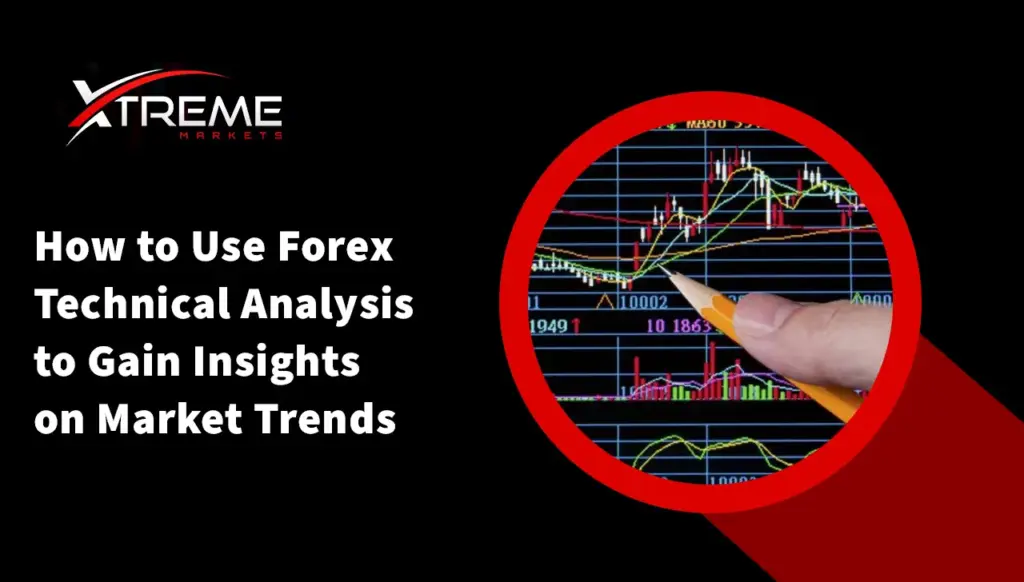
How to Use Forex Technical Analysis to Gain Insights on Market Trends

Forex trading provides opportunities to profit from market fluctuations, but understanding trends and key data is crucial for effective trading. This is where technical analysis becomes essential, as it focuses on price movements and trading volume to uncover patterns and market direction.

What Is Technical Analysis?

Technical analysis involves studying price movements and volume to predict future market behavior. By examining price action and volume trends, traders can identify patterns that offer insights into possible market directions.

Forex market analysis is typically divided into three key categories:

1. Fundamental Analysis

Fundamental analysis examines macroeconomic indicators such as inflation, economic growth, employment figures, and political events. This analysis helps traders understand why currencies rise or fall and how economic factors may impact currency performance.
» New to Forex? Start by learning the basic forex terminology and types of pending orders.

2. Sentiment Analysis

Unlike fundamental analysis, which focuses on economic data, sentiment analysis evaluates trader sentiment toward specific currencies. By analyzing the collective outlook of traders, sentiment analysis helps identify trends and potential reversals. Although simpler than other methods, it is equally important.
» Learn more about market sentiment by exploring the psychology behind trading.

3. Technical Analysis

Technical analysis focuses exclusively on price movements and trading volume. Traders use various technical indicators to spot support and resistance levels, as well as potential trend reversals. Popular indicators include moving averages, MACD (Moving Average Convergence Divergence), Bollinger Bands, and oscillators like the RSI (Relative Strength Index).

Applying Forex Technical Analysis

To apply technical analysis effectively, traders need a solid understanding of currency markets, trading cycles, and chart patterns, such as support and resistance levels and trendlines. Additionally, familiarity with key technical indicators is essential.

1. Identify Trends Using Price Movements

The first step in technical analysis is identifying trends by examining price movements. Analyzing historical data and chart patterns helps traders spot upward or downward trends in currency pairs, allowing them to anticipate possible trend reversals or accelerations.

2. Plot Support and Resistance Levels

Once a trend is identified, traders can plot support and resistance levels on the chart. Support levels are where buying interest typically increases, while resistance levels are points where selling pressure tends to rise. Recognizing these levels helps traders determine potential entry and exit points.
» Not sure about currency pairs? Learn the difference between major and minor currency pairs.

3. Determine Entry and Exit Points

Knowing when to open or close a position is crucial in trading. Overbought or oversold market conditions are often used to make these decisions. Indicators like the RSI can help traders identify whether a currency pair is in an overbought or oversold zone.
» Looking for more forex trading tips? Enhance your skills with our free beginner trading course.

4. Manage Risk

Risk management is vital when trading forex. Analyzing historical data helps traders identify risk levels associated with certain trades, enabling them to adjust strategies. For example, if a trader observes that a currency pair becomes overbought at certain levels, they may take smaller positions to minimize exposure.
» Interested in other pairs? Consider exploring exotic forex pairs.

Charting Success with Forex Technical Analysis

Forex technical analysis is a powerful tool for analyzing market behavior and identifying trends. By studying price action and forex trading volume, traders can spot patterns that may guide their trading decisions. However, incorporating a sound risk management strategy is equally important to ensure traders can adjust their approach based on their risk exposure.

Understanding Pips and Pip Value Calculation in Forex Trading

Understanding Pips and Pip Value Calculation in Forex Trading

Pips and lots in forex are like the building blocks of trading. A pip is the tiniest price change in a currency pair, usually the fourth number after the decimal (like 0.0001). So, if EUR/USD moves from 1.2000 to 1.2001, that’s a 1-pip move. Lots, on the other hand, tell you how big your trade is. A standard lot is 100,000 units of currency, but there are also mini lots (10,000) and micro lots (1,000) for smaller trades. Pips and lots together help you figure out how much money you’re risking or making. For example, if you trade one standard lot and the price moves 10 pips, that’s a bigger profit or loss compared to trading a micro lot. Understanding pips and lots in forex is super important because it helps you manage your trades and stay in control!

In the forex market, currency pairs are quoted with decimal points to reflect the precise exchange rate between two currencies. This system allows traders to track even the smallest price movements in the market.

What is a Pip in Forex Trading?

A pip, short for “percentage in point,” is a standard unit that measures the change in value between two currencies.

For most currency pairs, a pip refers to the fourth decimal place (0.0001). For example, if the EUR/USD moves from 1.1015 to 1.1016, the price has increased by 1 pip. However, pairs involving the Japanese yen (JPY) are quoted with two decimal places (0.01) due to the yen’s lower value compared to other major currencies. For example, if the USD/JPY moves from 144.30 to 144.32, it has moved by 2 pips.

What is a Pipette?

In addition to pips, brokers often quote forex prices with 5 or 3 decimal places, known as pipettes or “points.” A pipette equals one-tenth of a pip. For example, if EUR/USD increases from 1.10161 to 1.10162, it signifies a movement of 0.00001 USD, or 1 pipette. Similarly, if USD/JPY moves from 144.323 to 144.324, that’s an increase of 0.001, or 1 pipette.

How to Calculate Pip Values

The monetary value of a pip depends on the trade size and the specific currency pair. Traders can calculate pip values using simple formulas.

  • For direct currency pairs (where USD is the quoted currency, such as EUR/USD):
    Pip value = point value × volume × contract size
    For example, trading 2 lots of EUR/USD would result in a pip value of 2 USD.
  • For indirect currency pairs (where USD is the base currency, such as USD/JPY):
    Pip value = (point value × volume × contract size) ÷ exchange rate
    For instance, with USD/JPY at an exchange rate of 144.324, trading 2 lots would result in a pip value of approximately 1.39 USD.

Understanding pips is crucial for assessing market movements, managing risk, determining position sizes, and gauging the effect of price changes on your trades. This knowledge equips traders to make well-informed decisions and manage their trades with precision.

Try learning how pips work in a risk-free environment by using a demo trading account.

Top 7 Trading Strategies for Beginners on Xtreme Markets

Top 7 Trading Strategies for Beginners on Xtreme Markets

Trading in financial markets can seem daunting, especially for beginners. Whether you’re trading stocks, forex, or cryptocurrencies, it’s essential to have a clear strategy in place. Xtreme Markets, known for its diverse offerings and cutting-edge technology, provides a great platform for new traders to test their strategies. If you’re new to trading and looking to maximize your potential, here are seven beginner-friendly strategies you can adopt to get started on Xtreme Markets.

  1. Trend Following Strategy

One of the most popular and simple trading strategies is trend following. The idea is straightforward—identify the direction of the market (upward or downward) and trade in that direction. In an uptrend, you buy assets and hold them until the trend reverses. In a downtrend, you can sell assets or short them to profit from falling prices.

  • How it works on Xtreme Markets: Use technical indicators like moving averages or trendlines to confirm the direction of the market. Xtreme Markets provides charts with built-in tools to help identify these trends easily.
  1. Breakout Trading

A breakout strategy involves identifying key levels of support and resistance, then waiting for the price to “break out” beyond those levels. Once the price breaks through resistance, it can continue moving higher, and breaking through support can signal further decline.

  • Why it works for beginners: Breakout trading doesn’t require deep market analysis, and you can set stop-loss orders to minimize risk. On Xtreme Markets, you can easily place these orders to manage your trades effectively.
  1. Swing Trading

Swing trading involves holding onto trades for several days or even weeks, making it a slower-paced alternative for beginners who can’t monitor the market constantly. The goal is to capture price swings within a larger trend.

  • Best for Xtreme Markets: This strategy works well in a market with volatility. Xtreme Markets’ advanced analytics and market data can help identify swing trading opportunities and allow you to set alerts for potential trade setups.
  1. Day Trading

Day trading is the practice of buying and selling assets within a single trading day, without holding any positions overnight. While it’s fast-paced, beginners can start small and learn to execute trades quickly.

  • Why beginners can benefit: Xtreme Markets offers real-time charts and fast execution, which is crucial for day trading. With its intuitive platform, you can set up instant buy/sell orders and use leverage (with caution) to maximize your trading potential.
  1. Scalping

Scalping is an ultra-fast trading strategy where you make multiple trades over short timeframes (minutes or seconds) to take advantage of small price movements. The idea is to accumulate small profits that add up over time.

  • Why it’s beginner-friendly: While scalping requires quick decision-making, it doesn’t involve holding positions for long. Xtreme Markets’ quick order execution and low spreads make it ideal for traders looking to scalp assets like forex pairs or cryptocurrencies.
  1. Dollar-Cost Averaging (DCA)

Dollar-cost averaging is an investment strategy rather than a short-term trading technique, but it’s excellent for beginners. The idea is to invest a fixed amount of money at regular intervals, regardless of the asset’s price, to average out your entry cost over time.

  • How to use it on Xtreme Markets: This strategy works well for beginners who want to slowly build their portfolio over time. You can set up automated investments or purchase assets periodically on Xtreme Markets to reduce the impact of market volatility.
  1. Copy Trading

If you’re not confident enough to develop your own strategy, copy trading allows you to mirror the trades of experienced traders on the platform. It’s an excellent way for beginners to learn by observing the decisions of seasoned professionals.

  • Why Xtreme Markets stands out: With Xtreme Markets, you can find a variety of top-performing traders to follow. The platform provides transparency about the trader’s performance, strategy, and risk level, allowing you to make informed decisions when choosing someone to copy.
Final Thoughts

While trading comes with risks, having the right strategies can significantly improve your chances of success, especially on platforms like Xtreme Markets. For beginners, it’s essential to start small, stay disciplined, and continuously learn from each trade. Whether you opt for trend following, breakout trading, or even copy trading, these strategies offer a good foundation for your journey in the financial markets. Remember, patience and a well-structured plan are key to long-term success.

What is Social Trading? Learn the Basics and Benefits

What is Social Trading? Learn the Basics and Benefits

How actively do you engage in trading? If you’re reading this, you likely have a good grasp of the expansive world of CFD trading and the broader financial markets.

You may have noticed a growing immersion in trading culture; the rise of the retail trader has indeed made a significant impact globally.

As the modern trading landscape evolves, so too does the concept of social trading. But what exactly is social trading? Are you currently participating in it?

This relatively new approach, where individuals trade alongside peers with similar financial interests, is gaining traction within the trading community. Let’s explore the fundamentals of social trading and how you can get involved.

Social Trading: An Overview

You might have encountered various sub-trends within online trading, prompting questions like: What is social trading? What is copy trading? Are they synonymous?

While they are interconnected, social trading and copy trading are distinct concepts in the contemporary trading ecosystem. Let’s clarify these terms and see how they can enhance your trading experience.

Social trading has gained momentum in recent years, influenced by multiple factors, including global events. For example, the pandemic in 2020 significantly contributed to its popularity.

To recap, the onset of the pandemic led to market crashes, causing substantial financial upheaval for many individuals. As jobs were lost and incomes diminished, the retail trading phenomenon surged, with Charles Schwab dubbing 2020 “Generation Investor.”

Since then, numerous individuals have turned to Forex and CFD brokers to learn about stock market trading. Education is crucial in this field, as trading involves inherent risks. The more knowledge you gain and the better your risk management, the greater your chances of success.

While many new traders have developed their trading styles and preferred market sectors, social trading has carved its niche. An increasing number of retail traders are gaining confidence in their strategies but may lack the time or expertise for certain markets.

The term “social trading” reflects the growing trend of traders using copy trading to enhance their activity. This concept echoes the older strategy of mirror trading, which focuses on emulating another trader’s strategy rather than copying exact positions, as in copy trading.

Now that we have some context, let’s delve deeper into the question: What is social trading?

If you want to explore trading further, consider opening a free demo account with Xtrememarkets to practice with virtual funds.

Understanding Social Trading

So, what is social trading? In its simplest form, social trading involves investing that emphasizes community engagement—investors can observe and follow the trading behaviors of others.

This community typically exists on a dedicated platform where traders can monitor each other’s activities, exchange opinions, and contribute insights.

Social trading offers a unique perspective on analyzing financial data based on the actions of successful traders, with the option to use copy trading to replicate their strategies.

Why has social trading become so popular? It allows participants to engage with little or no prior knowledge, especially when following seasoned traders to learn from their expertise. The information is usually presented in an accessible manner for all levels of education, making it an appealing opportunity for everyone.

As a concept, social trading encompasses both copy trading and mirror trading, which are specific strategies that can be leveraged within the social trading environment.

The rise of social trading may also challenge traditional roles within the finance sector. For example, trust in wealth management advisors has waned since the financial crisis, leading individuals to take control of their financial futures. Social trading, as a low-cost solution, is gaining traction.

Before we conclude this section, let’s highlight some fundamental differences:

  • Mirror Trading: Emerging in 2000, mirror trading is closely associated with automated trading. It involves replicating a strategy developed by a trader, which is hosted on the trading service provider’s server, allowing users to execute the strategy.
  • Copy Trading: Successful traders can opt to allow others to copy their exact positions for a nominal monthly fee. While those copying retain control over their settings, they essentially set up their accounts to mirror the trades of the trader they choose to follow.
  • Social Trading: This overarching concept encompasses both mirror and copy trading, functioning as a platform where traders can view, share, and comment on each other’s activities.
Benefits of Social Trading

Social trading, particularly through copy trading, offers several potential benefits. When you identify a trader of interest, you can quickly and easily sign up for copy trading, gaining exposure to different markets and skills.

Here are some of the primary benefits of social trading:

Networking Opportunities: Connect with other traders to ask questions about markets, techniques, and events that affect investors.

Accessible Learning: Start trading without prior experience, learning progressively from seasoned traders through practical engagement.

Reduced Emotional Pressure: Traders who struggle with emotional decision-making can invest more wisely by following the positions of others.

Conclusion on Social Trading

If you’re reading this and are registered with Xtreme Markets, you’re likely on the right path in this financial revolution.

Embrace the upward trend and enhance your investing strategy by exploring CFD trading and other investment opportunities.

Always prioritize risk management and only invest what you’re comfortable potentially losing—this is the foundational principle of successful investing.

The Long-Term Forex Trading Strategy Guide

The Long-Term Forex Trading Strategy Guide

This article delves into long-term Forex trading strategies, outlining best practices and key considerations for traders. While many professional traders are drawn to day trading due to its excitement and potential for quick profits, long-term (positional) traders can also see significant gains over time.

Introduction to Long-Term Forex Trading

Can you trade Forex long-term? Many are familiar with short-term strategies like day trading, but long-term Forex trading is also quite popular.

Some traders believe long-term trading offers better profit potential than day trading, though results vary based on individual experience. Ultimately, whether long-term trading is superior comes down to personal preference. This article aims to provide a clear overview of what long-term Forex trading entails and important factors to keep in mind when adopting this approach.

Understanding Long-Term Currency Trading

Before diving into the mechanics of long-term Forex trading, it’s crucial to understand what it involves. Traders who adopt this strategy aim to earn at least 200 pips per trade, though they have fewer opportunities compared to day traders. This requires careful preparation and extensive knowledge.

Long-Term Trading Strategies

What’s the best strategy for Forex trading? While there isn’t a definitive answer, long-term positional trading is a popular approach. This strategy involves identifying and riding a trend over weeks or even months. In some cases, traders may follow a trend for over a year.

In this strategy, traders buy based on expectations and sell based on facts. For example, in 1992, speculators like George Soros shorted the British pound, doubting the UK’s ability to maintain fixed exchange rates. When the UK pulled the pound from the European Exchange Rate Mechanism (ERM), Soros made over £1 billion. When trading a currency pair like GBP/USD, it’s essential to consider economic events in both the UK and US.

Examples of Long-Term Forex Trading

Let’s explore an example of a long-term Forex trading strategy. Imagine you’re a trader based in the US, and recent political events suggest a potential impact on the USD. You analyze the situation and predict where the USD is headed.

If your analysis is correct, you may open a USD pair position to reflect your expectations. However, it’s essential to consider the second currency in the pair. If you’re seeking stability, you might choose a quote where the second currency is less affected by external factors, such as the USD/JPY pair, given Japan’s historical currency stability.

Once your predictions are in place, create a detailed list of expected events and their possible outcomes. This is key to developing a robust long-term Forex strategy or any other long-term currency trading approach.

Key Practices for Successful Long-Term Trading

While traders use varying approaches, some general principles can enhance long-term Forex trading strategies. These principles are centered on risk management and the nature of the Forex market.

  1. Avoid Emotional Trading
    Emotional decision-making can derail your trading success. Stick to your strategy regardless of fluctuations. For each trade, set a clear profit target and stop-loss. Define these parameters before starting any long-term Forex strategy.
  2. Use Low Leverage
    When employing a long-term strategy, use small volumes relative to your margin. This helps you weather market volatility without prematurely triggering stop-losses.
  3. Monitor Swaps
    Swaps, the fee for holding positions overnight, can affect your profits. While some swaps are positive, many are negative, so it’s important to account for these fees when planning long-term trades.
  4. Effort vs. Return
    Even the best strategy won’t always meet your profit expectations. If you use minimal leverage and capital, your returns may be proportionally small. Always evaluate the time and effort spent on trading relative to your potential monetary gains.
Conclusion

Long-term Forex trading offers distinct advantages compared to short-term approaches and may suit certain traders better. Whether you’re just starting or looking to refine your existing strategy, understanding the essentials of long-term trading can help you make more informed decisions.